

There is a popular saying: History does not always repeat itself but it often rhymes. Like other scholars and commentators, I look to history to orient myself to our current calamities. One current line of analysis centers on parallels between Trumpism and McCarthyism–the longest and most public Red Scare in American history.
I take up here the discordant parts of the parallel and the parts often omitted, for example, the role of Democrats and the harms inflicted on thousands of Americans in the Lavender Scare, a companion to the Red Scare. I start with where Trump and McCarthy rhyme.
Dark Nights of the Past
Many scholars and commentators search for those dark times in history that offer insights into the present. Although some focus on European fascist regimes, others land on the post-World War II anti-communism crusade as the more relevant parallel. And there is plenty of evidence to support this thesis. The Trump regime projects their idealized split-screen image of 1950s America: There is the dark anti-communist hearings and the conspiratorial obsessions of Senator Joseph McCarthy on one screen. And there are the cheery, everyone-in-their-place Norman Rockwell scenes and post-war industrial boom on the other.
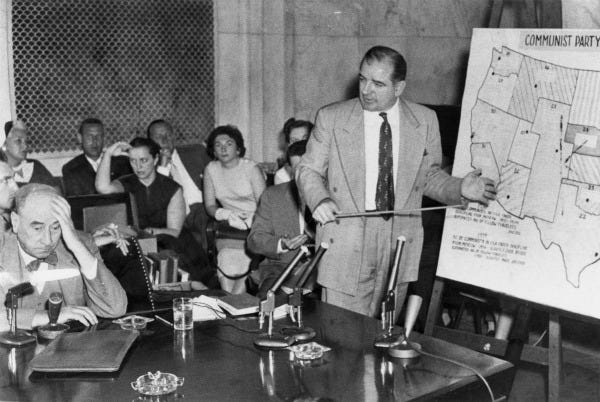
There are unmistakable similarities in Trump and McCarthy in their showmanship and intuitive understanding of television as a stage for political propaganda as well. Indeed, the McCarthy hearings were different from earlier Red Scares in the US because they were televised. The 1954 Army-McCarthy hearings were broadcast live on national TV over 36 days by major news networks. The hearings, with McCarthy thundering, “Are you or have you ever been a member of the Communist Party,” mesmerized and terrorized the nation. The hearings brought politics–and for many, television itself– into the living rooms of countless Americans. Trump’s performances in the Apprentice TV series, where the king-boss humiliates and fires “losers,” were part of his schooling in mass psychology, tutored by McCarthy attorney Roy Cohn.
In lock step with McCarthy, Trump in his second term expanded his obsessive prosecutorial campaigns against Republican and Democratic critics to the socialists, many of whom are winning (!!!) elections around the country. These leftists are not cast through his notoriously limited vocabulary of insults (e.g., cons, scum, crazies, low-IQ individuals.) Much like his strange admiration for Zorhan Mamdani, Trump goes above his lazy comfort-zone of the gutter. Portrayed as the hidden enemy within, part of the “Fifth Column,” socialists, according to Trump, sound good but are actually evil. Repeating rather than rhyming with Senator McCarthy, Trump declares that American socialists are “godless communists.” McCarthy never tired of equating communism with godlessness. (It is pretty funny to see this most godless and gaudy president in US history make such statements, the man who, if he read the Bible, would know that God punishes those who worship the Golden Calf of wealth and power, symbolized by Trump in his terrible interior design choices.)
The Lesser Evils
But before the monstrous Trump, we had the famously lesser evil of Biden. In fighting the bloated predations of Trump 2.0 and its revival of McCarthyism, it is easy to forget that the Biden/Harris administration partnered with Republicans to usher in this recent chapter of McCarthyism. That was just two years ago. While the Democrats did not lead the congressional interrogations of university presidents under the pretense of combatting anti-semitism, the Biden administration did enable the repression and the crackdown on faculty and students on campuses around the country.
The politics of the present rhyme with the past in places often overlooked in tracing historical parallels. Republicans and their right-wing allies have a long history of conjuring a Red Menace to scare the public into supporting their ruthless political agenda. Our Mad King, conjuring the Cold War, seems nostalgic for an old superpower to be cast as a Red Menace. The old Communist regimes have either collapsed or have proven themselves better at capitalism than American hyper-capitalism. For Trump, the sight of left-wing candidates winning races arouses Cold-War flashbacks and Red Hysteria: “Communism is the greatest threat to our country in its history, including even World War One, World War Two, Pearl Harbor, 9/11,” he screeches. In the more sober-seeming tones of so-called Democratic Centrists, taking on the left-wing of the Democratic Party means preparing for “the next war that is coming” against their left flank. Third Way, a leading centrist Democratic group, has committed $15 million to discrediting democratic socialism in the next election cycle.
Returning to McCarthyism and whether it rhymes with today’s red scare, the roles of Democrats and their liberal allies are often overlooked because they were not center stage. The Crucible, an allegorical play about McCarthyism written by Arthur Miller, is now regarded as a classic. It has for decades been performed or read in high school and college classes across the country. (As far as I know, The Crucible is not yet on the banned book lists, perhaps because allegories are famous for bypassing the censors. Indeed, it was Miller’s use of this allegory that provided some political cover for his play about the Red Scare during its scariest period.)
In 1968 Arthur Miller explains why he wrote the play as a drama about McCarthyism but one set in an early period of American history. The play is set in a Puritan colony of Salem, Massachusetts in the 1660s. A group of girls, caught dancing naked with each other by their Puritan elders, defend themselves by accusing older women of practicing witchcraft on them.
The Crucible is as much an indictment of liberals as it is an indictment of the Republican reactionaries. Alongside the clergy are various whisperers spreading gossip that fuel the witch hunts.
As Miller explains, “By 1950, when I began to think of writing about the hunt for Reds in America, I was motivated in some great part by the paralysis that had set in among many liberals who, despite their discomfort with the inquisitors’ violations of civil rights, were fearful, and with good reason, of being identified as covert Communists if they should protest too strongly.”
Miller continues: “The more I read into the Salem panic, the more it touched off corresponding images of common experiences in the fifties: the old friend of a blacklisted person crossing the street to avoid being seen talking to him; the overnight conversions of former leftists into born-again patriots; and so on.”
Political Hysteria and Sexual Repression
There is a strong current of sexual repression animating the hysteria and witch hunts that unfold in Miller’s play–a theme often overlooked in analyses of McCarthyism. Like the Puritan girls caught dancing naked in the woods at night, victims of McCarthyism faced accusations of sexual immorality. The Lavender Scare accompanied the Red Scare, leading to more civil servants being investigated and fired or having their careers destroyed after being exposed as homosexuals. President Eisenhower passed Executive Order 10450 in 1952, making it illegal for known homosexuals to work in the government. This Executive Order subjected all federal employees to in-depth investigations where friends, family, and acquaintances were asked to reveal details about the personal lives of the accused. Even having friends who were gay was grounds for the dismissal of government workers. After decades of successful gay rights organizing, Order 10450, much like sodomy laws, receded in enforcement. But the law was not completely repealed until 2017, when President Barack Obama ended the order on his last day in office. By then, Obama and the DNC had been pushed by activists and the Supreme Court decision to accept gay marriage.
Intergenerational Immunities
For young people whose parents or grandparents lived through McCarthyism, there may be a kind of intergenerational transmission of immunity in response to Red Scares. Growing up under the anti-communist epidemic that infected the country from 1946 through much of the 1950s, many older Americans may have passed on their antibodies to this political pathogen. A Fox News poll in March showed that 49% of all registered voters, including 72% of Democrats and 60% of independents, described capitalism as working not very well or not at all.
Majorities of young people, and particularly young Democrats and independents, now view socialism more favorably than capitalism. These younger generations have grown up under the most ruthless period of predatory capitalism.
Many may not be knowledgeable about the different traditions of socialism, but they do understand many of its principles. And they plainly see that a small group of obscenely wealthy people are hijacking their futures and wrecking the planet. Henry Ford, the ardent antisemite and anti-union industrialist, sagely observed, “home ownership gives working class people the belief that they too have a piece of the rock.” Owning a home creates an identification with the owning class. Young people no longer have a piece of that rock.
So the socialist threat now proclaimed with such alarm by corporate Democrats and Republicans alike enters the political stage as a different drama than earlier periods of reaction. In the past, red scares followed actual advances of the Left and Labor in American politics–advances repressed through political paranoia and hysteria. We no longer have the Soviet Union as the competing superpower fueling the anti-communist crusade.
As Aruthur Miller explains in a 1996 New Yorker interview, “McCarthy’s power to stir fears of creeping Communism was not entirely based on illusion, of course; the paranoid, real or pretended, always secretes its pearl around a grain of fact. From being our wartime ally, the Soviet Union rapidly became an expanding empire. In 1949, Mao Zedong took power in China. Western Europe also seemed ready to become Red—especially Italy, where the Communist Party was the largest outside Russia, and was growing.”
It is also worth noting that socialists in the US are among the most ardent critics of the Communist Party and Stalinism. Michael Harrington, a founder of Democratic Socialists of America (DSA), was part of the New Left that fought the Old Left and its ties to the Soviet Union. The centrality of democracy to the DSA vision of socialism grows out of decades of genuine struggle. While the Democratic National Committee finds little room for socialists under its corporate-sponsored Big Tent, progressives aligned with the DSA have found a more hospitable place to put forward programs and a vision of genuine progress. It is not so surprising that many young people have found more heart and soul in socialism than in the soulless world of monopoly capitalism.
A memo prepared for the House Republican Conference by a polling firm advised its members to “do your best” to link socialism and Marxism to communism. “Americans still hold communism as far more dangerous and alarming than socialism and Marxism,” the memo read. “So do not retreat to the softer label just because socialism alarms fewer in the abstract. Connect all three, fruit of the same poisonous tree, and let the family name carry the alarm.”
In this political season, we will see which tree proves to be poisonous. People are sickened by the Republican rot and fatigued by the talking points of corporate Democrats.
The political drought in America has produced an array of inspiring grassroots candidates, whether they describe themselves as socialists, social democrats, progressives, left-wing Democrats, left independents, or economic populists. Across their political differences, many of these candidates find unity in bringing power back to the people.
And they are not scared.
💬 Share Your Thoughts
Do you see meaningful parallels between McCarthyism and today’s political climate—or are the differences more important than the similarities?