In 1949, the German-Jewish philosopher Theodor Adorno produced one of the most widely cited lines in the postwar era:
“to write poetry after Auschwitz is barbaric.”
This aphorism was not a prohibition against poetry per se nor a taboo against art that represents the Holocaust. Rather, Adorno was condemning cultural practices that provide a comforting distance from the suffering it represents or from the societal dynamics that give rise to industrial scale murder. At the same time, Adorno insisted that it is “in art alone that suffering can still find its own voice, consolation, without immediately being betrayed by it.”
As a director of The Palestine Exception and SUMUD: A Doctor’s Report on Genocide and Survival in Gaza, I was invited along with my team to film the opening of Gaza—No Words—See the Exhibit at the Venice Biennale with the aim of producing a documentary that tells the story behind the exhibit.
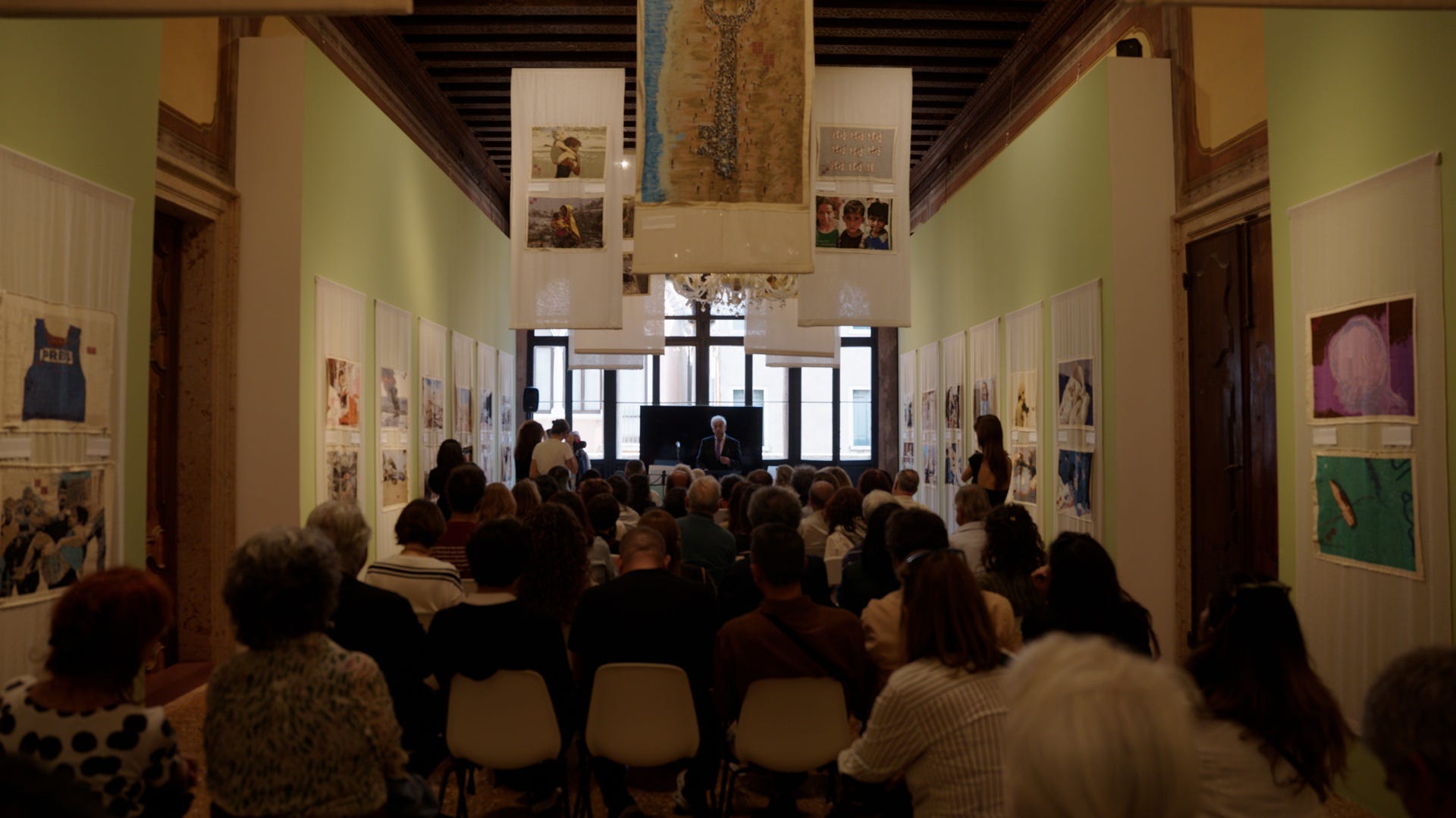
In filming the event, I was reminded of Adorno’s warnings on the politically repressive uses of art as well as his hopes for art that is faithful to its subject matter.
This hopeful vision was palpably on display at the opening in the main salon of the Palazzo Mora at the European Centre—one of the spaces for the officially recognized Collateral Exhibits. These independently organized projects undergo a competitive review process to be accepted as part of the Biennale outside of the national pavilions. Much like Palestine itself, these exhibits on the periphery are animated by a spirit of persistence.
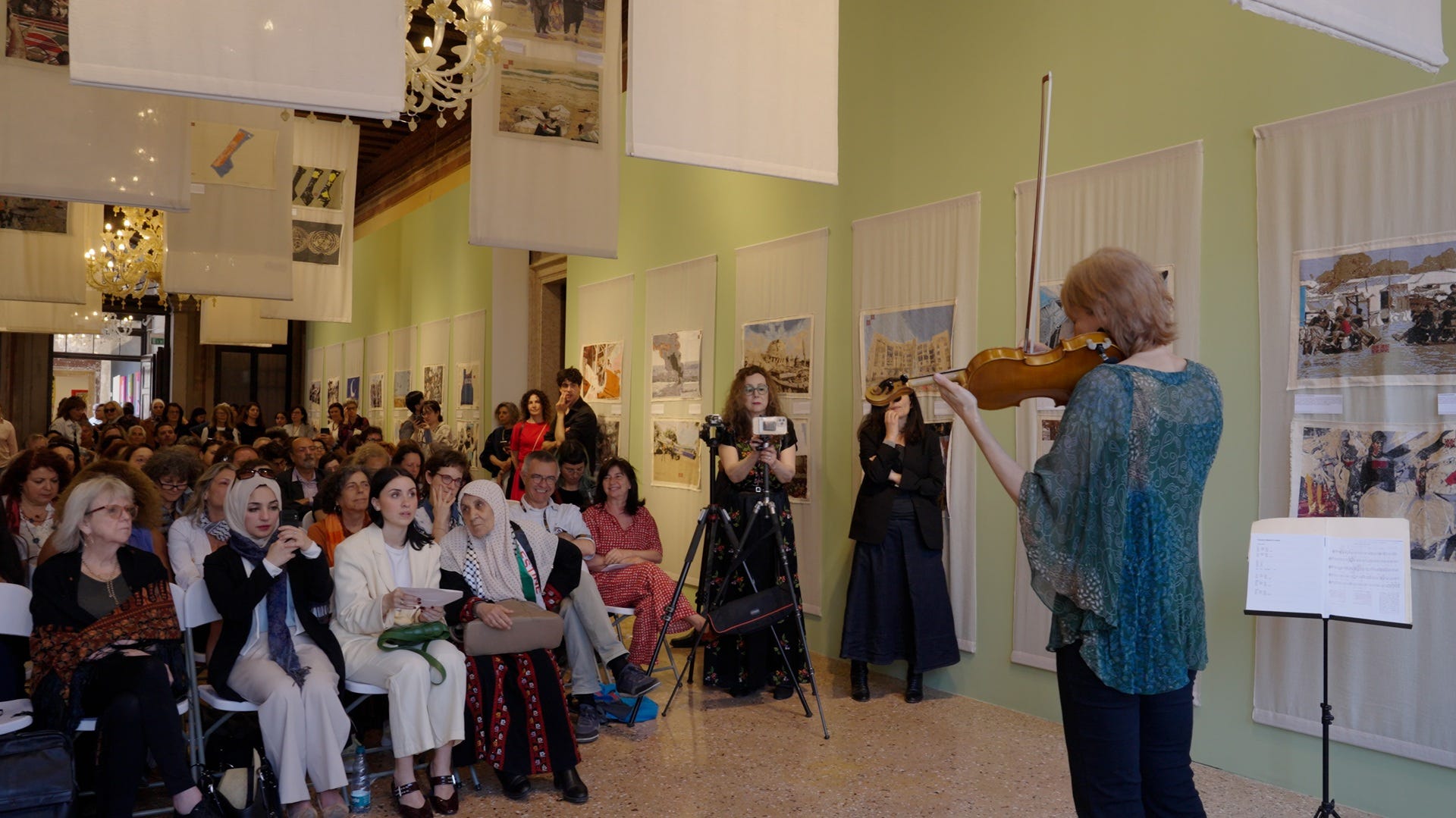
If the Venice Biennale is the Olympics of the art world (as its often described), the collateral exhibits are its long-distance runners. This most decidedly characterizes Gaza—No Words—See the Exhibit. As large protests and boycotts of Israel’s participation shook many of the national exhibit halls, the embroidery exhibit at the Palazzo Mora offers a consoling space to think, to feel and to recognize what is happening in Gaza.


Faisal Saleh explained the meaning of the “No Words” in the exhibit’s title. Saleh is founder and director of the Palestine Museum US and part of the team that produced the exhibit.
“As the title of this exhibit suggests, no speech and most certainly no set of words from this podium can fully capture what hangs on these walls today,” Saleh explains in his opening remarks. He describes the urgency of the project as global protests fail to stop the genocidal destruction of Gaza. “It was a bold proposal and a painstaking undertaking and the result is this exhibit. It is the result of over 60 embroiderers, five field coordinators and a team of four.”
Two of the team members—Jan Chalmers and Ibrahim Muhtadi—were not able to be present for the opening ceremonies. Team members Faisal Saleh and Jehan Alfarra were there to present the project to the attendees gathered.
Along with Saleh, Alfarra spoke to the meaning of “No Words” in the exhibit title.
“We will make no attempt to explain or describe these stories. The panels speak for themselves. These remarks are simply an offering of gratitude and recognition to all those who made this work possible. And they are in honor of all the women who spent months stitching scenes most of the world could barely bear to look at for seconds. And with that said, I would first and foremost, like to begin by expressing my utmost appreciation for Faisal Saleh standing before you today and for the Palestine Museum, U.S., without whom this exhibit would not have been possible.”
The creativity, caring and deep suffering of the Palestinian people are woven into these magnificent panels. And they collectively present an indictment of Israel’s ongoing genocidal campaign. Each of the 100 panels tells a story of horrific suffering. But they project a feeling of deep intimacy as well. The panels are based on photographs, many taken by photographers who took enormous risks in documenting the destruction in Gaza.


The photos were transformed into patterns that became the basis of this use of the traditional cross-stitch craft of tatreez to tell a collective story. The exhibit honors these heroic journalists who documented the genocide, many of whom died in the course of carrying out this vital work.
The exhibit also includes a video titled Cartography of Genocide produced by Forensic Architecture, based in the UK.
“With genocide, like any other military campaign, there’s an architecture to it,” founder Eyal Weizman explains. Their mapping of the systematic nature of the destruction includes definitions from the UN charter of 1948. “It’s about whether the scale of atrocities, whether the patterns between things that are happening constitute a systemic campaign that is designed to destroy people.”
This visual mapping of the structure of the genocide offers a distinctive counterpoint to the mournful beauty and intimacy of the embroideries.


It is an honor to be working with the Palestine Museum on a documentary that brings the story of these embroidery panels into the medium of a film. There will be words in the form of thoughtful observations and insights.
But as a film production team, we are guided by the quietly disturbing spirit of this project. Art can speak in ways that words fail. Art can provide new ways of seeing in the darkest of times.
Watch the Trailer

Support the Film
Please click the button below or scan the QR code to donate to the film.