

This is a sad week for many of us here in Portland, Oregon. On July 23rd, Jacob Hoopes, a 25-year-old activist, was driven by his parents to a federal facility to begin a 30-month prison sentence. He pled guilty to aggravated assault on an ICE officer during a pitched confrontation between the agents and protestors on June 14th 2025. Local news captured the ghastly scene that night of over a hundred people choking through clouds of flash grenades and tear gas, many pushing back against the force of ICE agents. The confrontation, declared a riot by police, followed a citywide “No Kings” protest that drew thousands earlier in the day.
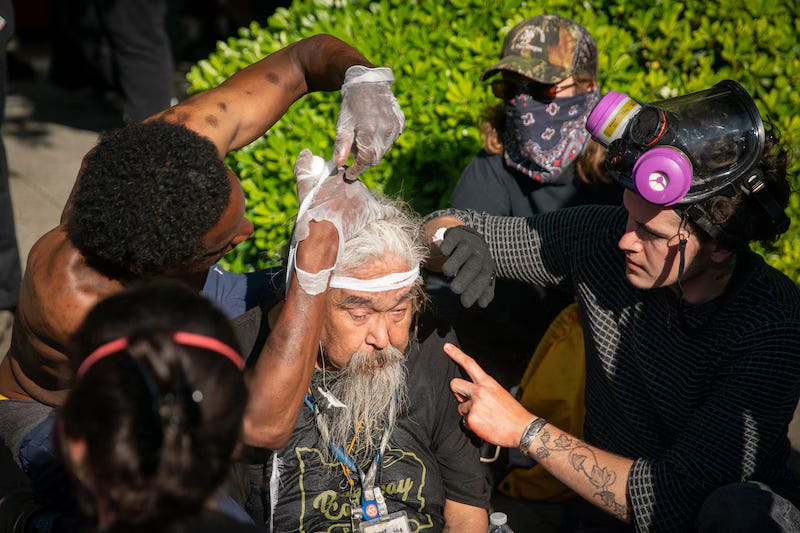
Jacob was part of the protests documented by the Oregonian, the major local paper. In the photo above, Jacob is seen providing first aid to an injured protestor (an image not included in the prosecution’s case). He was then identified by the DHS officer whom he hit. This image was then plugged into facial recognition software. The FBI used this surveillance technology to identify Jacob as a recent Reed College student. Within weeks, the FBI received the personal information they needed from the safety officer at the school to arrest Jacob--an action in violation of college policy and for which he was later fired.
Jacob had thrown a rock inside the ICE building that resulted in a gash above the agent’s eye—an injury requiring medical treatment but resulting in no lasting damage. He pled guilty to aggravated assault on a federal officer—a charge that carries a maximum statutory penalty of up to 20 years in federal prison. The charge is elevated from simple assault if the crime involves a deadly or dangerous weapon or results in bodily injury. The deadly weapon in this case was a rock, and the bodily injury was a gash above the eye. Federal agents have special protections as victims that elevate the sentencing level if the assailant is believed to have known that the victim was a federal officer.


I have known Jacob for over a year, mainly through our work together as grievance officers in a local organization. He has the temperament as well as the principles that make him well suited for the adjudication of grievances. It requires a capacity to listen to emotionally distressed people who hold opposing perspectives on events and to see both sides of a conflict.
In making his plea before the court and before his Quaker conscience, Jacob brought this same capacity to hold conflicting positions in mind. In the courtroom where prosecution and defense made their final arguments before the judge, the prosecutor zoomed in on video of Jacob throwing a rock as well as him joining others in thrusting a stop sign into a gate. The prosecutor painted a picture of a person acting with violent intent, omitting from her prosecutorial picture the larger scene of what ICE agents were doing, omitting as well assaults on protestors that night.
Jacob recognized the skewed and narrow story presented by the prosecutor. At the same time, he felt that he had violated his own conscience. In entering a guilty plea, he took personal responsibility for his action on the night of June 14th and admitted that throwing rocks at ICE agents was morally wrong.
While genuinely felt, Jacob’s statement of personal responsibility was part of legal rituals around plea bargaining. From the civil rights era through other movements using tactics of civil disobedience, activists often take a guilty plea to pay a fine, accept requirements for probation and to find a way hopefully to get back on the streets. Plea bargaining, however, is a notoriously corrupt and unjust part of the carceral system. Legal counsel includes assessing the risks of going to trial versus pleading guilty to reduced charges. In negotiating a plea in a racist and class-based system of criminal justice, people sometimes plead guilty to crimes they did not commit.
In issuing her sentence, Judge Adrienne Nelson acknowledged that those few minutes on a tense evening of June 14th had changed his life forever. He would spend a significant part of his young adulthood in prison and carry the consequences of being marked as a felon. In Oregon, voting rights are restored automatically on release from prison. This is not the case in many other states.
The judge offered that version of compassion so often issued by those in positions of power. She spoke of Jacob’s many strengths, how he seemed to genuinely care about social justice, and how he had complied with every requirement of the court. And she spoke to his many strengths and his notable “resilience.” “You will be okay,” she consoled.
She was right, I thought. He is resilient and he will be okay. Yet this faux-parental pat on the back, disgusted me.
Survivors of violent assaults by police or military forces are often praised as resilient—a form of recognition that Omar El-Akkad takes up in relation to Palestinian suffering in the film SUMUD. He points out how the rhetoric of resiliency is often deployed to minimize or downplay harms inflicted.
In this federal courtroom, facing a packed room of supporters and the defendant, the judge rationalized her very harsh sentence with trite uplifting words. In sharing her further thoughts, she added the empirically false but politically potent rationale of “deterrence.” There were expectations from the public, she claimed, that activists who crossed the line from peaceful protest to violence would face serious consequences in federal court.
Before he left to begin his prison term, I interviewed Jacob for the Old Mole Variety Hour on KBOO Community Radio—an interview that followed a series of off record conversations. In the interview, we talk about what happened during that night of anti-ICE protests, the SWAT team that arrived at his house to violently arrest him, and the criminal investigation that followed. And he reflects on his difficult path from protestor to prisoner. One area of personal struggle centers on reconciling his philosophy as a Quaker, deeply rooted in the Friends’ tradition of non-violence and pacifism, with his violent action on the night that he joined the ICE protests.
In our interview, I pushed back some on Jacob’s pacifist perspectives on non-violence. His arguments were both moral and strategic. Violent actions against other people, even in resisting state violence, can inflict moral damage on both parties to a conflict. However, this moral stance of pacifism in the Quaker tradition includes a moral duty to act in the face of injustice.
Jacob also took the strategic stance that violence is not an effective way of creating radical change. We agreed that the use of violence in resisting State violence is a complex topic with a long history of debates within the Left. The Justice for Palestine movement has revived some of these old debates. “In the First Intifada,” I asked Jacob, “youth in Gaza threw stones at the IDF. Don’t Palestinians have the right of violent forms of self-defense, forms of action that have followed waves of violent suppression of peaceful protest?” His response centered on finding the work that he could best do in the movement. This work would not be on the barricades.
Whatever the rights of oppressed people to take up stones and guns in righteous resistance, we agreed that engaging with the violence of the State requires organized strategy. Jacob had not been part of activists’ discussions on dealing with heated encounters with ICE agents and was ill-prepared for the emotional and physical intensity of what unfolded that night. Even when morally or strategically defensible, the consequences of throwing rocks at the oppressor are far more violent than the act itself.
Jacob will be okay because the movement of which he is a part continues this struggle. For me, he is one of our heroic Davids fighting the Goliaths of our times.
🎙️ Old Mole Variety Hour
Listen to the interview on KBOO Community Radio, Monday July 27th at 9 am PST or later on the Old Mole Variety Hour podcast.
💬 Share Your Thoughts
How should social movements navigate the tension between non-violence, self-defense, and resistance when confronting state power? What lessons can we draw from the ongoing federal crackdowns on ICE protests?
Marguerite Chandler - An excellent book on this subject: Blueprint for Revolution: How to use rice pudding, Lego men, and other nonviolvent techniques to galvanize communities, overthrow dictators or simply change the world by Sroja Popovic
Minor correction - voting rights in Oregon are not restored automatically, they have to re-register.