

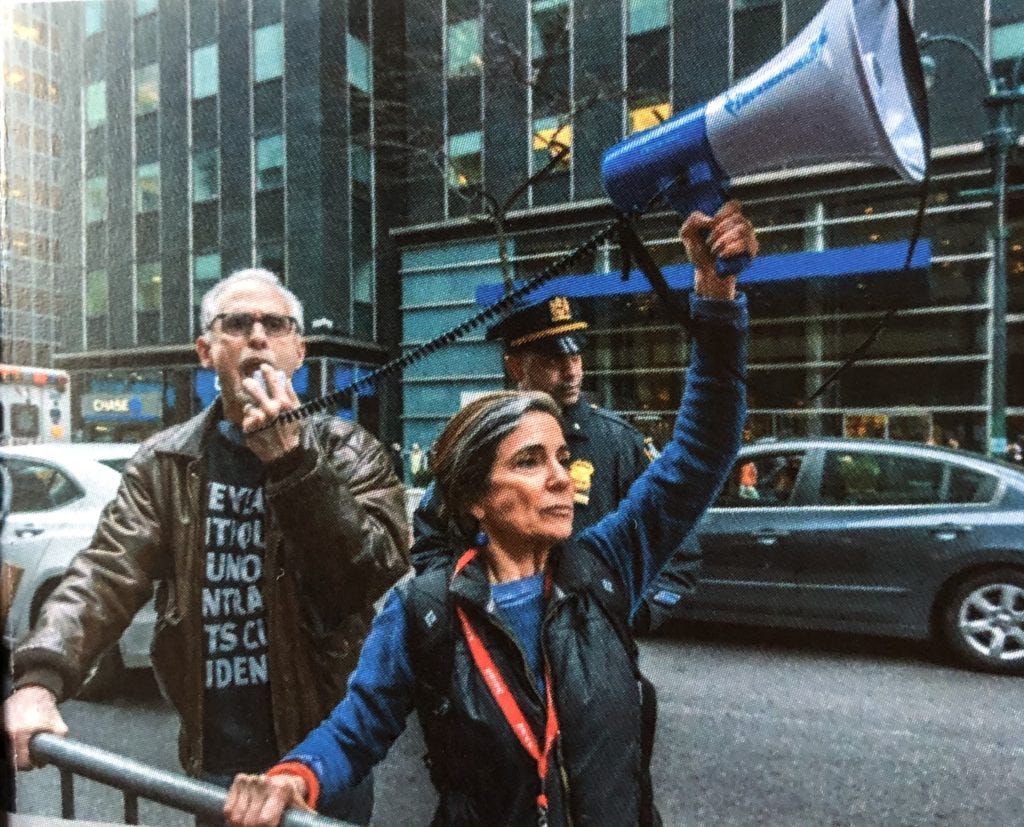
I recently spoke with Michael Fabricant about his new book, The Struggle for Public Goods in the Shadow of Fascism: Hope at Dusk. Michael is a Professor of Social Work, at Hunter College, City College of New York (CUNY). He is author or co-author of 10 books, including Austerity Blues: Fighting for the Soul of Public Higher Education and The Changing Politics of Education: Privatization and the Dispossessed Lives Left Behind.
Jan:
I’m talking today with Michael Fabricant, Professor of Policy and Community Organizing at the Silberman School of Social Work, a part of Hunter College. He’s written 10 books and numerous articles on the impact of disassembling and privatizing welfare state programs during the past 50 years. His work extends beyond the academy.
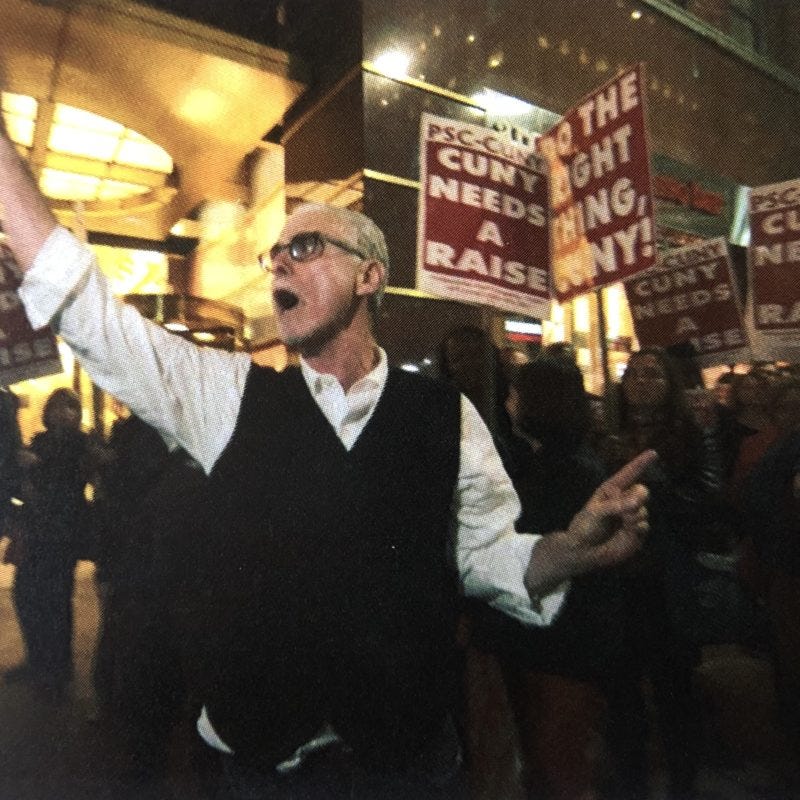
Over the past 40 years, he has helped lead campaigns that expand housing and development programs and homelessness services in New Jersey. Mike also served as a principal officer for 13 years of the Faculty and Staff Union of CUNY, the PSC. Welcome to KBOO and the Old Mole Variety Hour, Mike Fabricant.
Michael:
Thank you, Jan. Terrific to be here.
Jan:
And congratulations on your fabulous and timely new book, The Struggle for Public Goods in the Shadow of Fascism, Hope at Dusk. Let’s start by bringing in your own background in social work as well as activism into this project. There are now more books than we could count on fascism.
It’s become a very big topic during the Trump era. There are debates about whether the Trump regime is fascist, neo-fascist. Even Robert Paxton, the historian you draw on in your book, seems to have shifted in how he would describe the Trump regime in terms of whether it’s useful to think of it as fascist.
So let’s start with what you bring to this topic from your own field of social work.
From Neoliberalism to Evisceration
Michael:
Sure. Thank you. I want to back up just a little bit.
What I bring to it also is having grown up working class. I grew up on the edge of poverty, and the consequence of that is that I was familiar with the differences, modest and substantial, that the welfare state in that period made for my family. And then watching over the last 40, 50 years, the ways in which it’s been so eroded that those kinds of differences are less and less available to others, especially now to people of color and also to people who are migrating to America.
So having said that, I’ve spent most of my life, my work life, writing about different parts of the welfare state, from the practice in nonprofit agencies, to public education, to higher education, and so on. And there are some through lines associated with those studies. And one is the privatization, the disinvestment, and austerity, none of which is new, all of which has been traced.
But I think it foreshadows what we face presently, which is the effort to totally eviscerate the welfare state to the extent that it is dependent upon and contingent, its programs are contingent upon tax rates that are redistributive, that ultimately support the work in some expansive and at times even transformative ways.
So what brings me to this work is this kind of threshold moment of personally, politically, based on the work that I do in communities, and through my writing, that the very existence of a welfare state as we’ve understood it, is now being we’ve moved from neoliberalism to a stage of evisceration, there was a gradual undermining of it and diminishment of the welfare state. But now we’re looking at an evisceration of it.
And that then has to have a name. And I think we can no longer talk about this moment as neoliberalism, whatever we may want to call it, neofascism, fascism, fascism is a very slippery political language. But I think it has many of the qualities of the movement toward a fascist state, what’s missing is the takeover of the state by a fascist party.
Social Work Between Care and Control
Jan:
But I’d like to return to that moment, but stay with the particular experience that you bring through your own life experience, but also your field of social work. And I was struck by that, you know, the attentiveness to the idea of social welfare, as public goods, a kind of vision of social welfare that challenges the dominant conservative politics, and even the Democratic Party that has been hostile over the last 50 years, 40 years to the welfare state. But, you know, many people associate social workers with people who deal with the practical problems of poor people.
You know, if you’re in the hospital or a nursing home, or call child welfare services, there’ll be a social worker there to help you. And yet, there’s a left literature, an extensive left literature, on the role of social workers in managing the poor, and regulating the state, not only through the criteria for eligibility to services but often in the monitoring of poor families. So there’s both the kind of progressive story of social workers, dealing with the problems of people who are marginalized, who bear the heaviest weight of stress and insecurity that capitalism produces in this country. On the other hand, there’s a left literature on social workers as in this position of managing the poor.
How do you think about those traditions of your own field and what they bring to your book project?
Michael:
Well, I do think that both strains, there are two strains that exist, which is the institutional and even the professional surveillance and, and the kinds of policing, if you will, and controlling of poor people. But I think there is this other tradition, beginning with the settlement houses and continuing to this day, of really trying to work within communities to create a kind of power in order to change the conditions, a power that would change the conditions that exist in the most oppressed communities. Often, it was quite patriarchal, or it had a quality to it that was sort of from the top benefiting the bottom.
And it wasn’t a shared struggle. But nonetheless, it was a struggle to improve conditions. And it did.
A lot of what happened during the New Deal was a consequence of the social workers who came out of that settlement house movement and what they’ve learned. So it’s a dialectic, you know, between the institution, there’s an institutional drive over time, and then there’s a struggle outside and social workers leading for a period of time that struggle for something far more than the institution would provide. And it’s ultimately a back and forth between one set of political forces or power and another set of forces.
And the question then becomes one of where does the social work profession align itself? And I think historically, it has struggled to align itself with the greater investment in communities. I also think it’s been less and less effective doing it.
But then again, across the board, there’s been less and less effectiveness in promoting that investment. So in the end, this is about a choice and trade off. You know, yes, of course, the state has its flaws and the welfare state particularly.
But in the end, you’re left with a choice for privatization and austerity, or an investment that’s transformative in people’s lives through the welfare state. What is the welfare state? In my estimation, it’s not just services, it’s services and benefits, it’s anti-discrimination laws, and it’s also regulation.
It’s ways to improve the conditions of citizens across the country. And frankly, non-citizens, you know, folks who are struggling to achieve citizenship. And that’s the welfare state.
There is not and never has been an assurance that that’s going to happen in a maximal or even substantial way. It occurs and often it’s symbolic and or less than. To extend that, to make it far more effective, that requires vigilance, that requires struggle.
Folks not only have to achieve a victory, for example, of Medicare or Medicaid, or health programs or housing, they have to be vigilant in continuing to work to expand it and to protect what’s been won.
Welfare as a Public Good
Jan:
And that’s where you come in on the hope side. But staying with these different visions of the welfare state, you know, of social welfare. The term welfare has such a strong history of being stigmatized in this country through at least 50 years, even farther back than that.
I mean, you weigh into that in a way that resonates with a lot of how democratic socialists are now organizing around, like here in Portland, in Multnomah County, we have a preschool for all campaign that won an election. We’re still fighting to get those funds available that are not merit based access to child care service in the same way that the Mamdani administration in New York argued for preschool for all, as something even high income people should be able to access– kind of like public schools. How do you understand that vision of social welfare as a public good versus a merit based system?
Michael:
Well, let me begin by saying the promise of a democracy was some matter of equality. And if one is going to try to fulfill and struggle toward that promise, then it has to be a redistributive state that moves toward equality in relation to a democracy. Now we’re not naive enough to believe it’s going to be full equality, but, you know, greater equality, a substantial equality, especially on the economic side.
What we’ve seen is the opposite, as evidenced by all kinds of data on inequality. So having said that, in order to achieve it, one has to socialize profit, right? There’s a socialization of profit.
This is not a new idea. This is a historic idea. To socialize profit and wealth and so on in order to distribute it or redistribute it to meet that promise of a democracy, which is why the market and market forces have been so absolutely threatened by a welfare state from its very point of origin, because the welfare state promises something that the market doesn’t want to promise, that in its estimation, and those who are functioning in the market, do not want to have to countenance. And that is this question of equality, redistribution, taxation that’s associated with it, the question of regulatory provisions that have consequences for their profit margins, but protect the larger citizenry.
Jan:
So food safety would be part of that. And we’re seeing a lot of the attacks on many areas that you would include in this broader scope of health care. Yeah.
Michael:
Health care, housing, the question of affordability around food, public transportation, these are the kinds of things that Mayor Mamdani has talked about as affordability. I would talk about some of this as universal rights. These are rights that every human being should have access to transportation, public transportation, housing that meets certain standards, and so on.
That requires investment, a public investment. And in this country, presently, any kind of massive redistribution is a third rail, right?
And power politics has no interest in that kind of investment, public investment. And so when you talk about public investment or goods and services, the welfare state, which is not earned, but has been, in many instances, just scapegoated for any one of a number of reasons. That’s not to say it does not have flaws.
It has many. But again, that’s about the vigilance of those who are served by it and others to make certain it does what it is expected to do. We’re left in a circumstance where this is about power.
This is about power. Either money is going to be redistributed to the citizenry in ways that maximize their potential and their subsistence or survival, or it’s going to be hoarded by the market and wealth. And I know that sounds like a binary, but that’s fundamentally where we are.
Debates on Fascism
Jan:
And so where we are is this ongoing debate in the left and also elsewhere, from different political perspectives on whether to have this continuity framework for thinking about the problems with the slashing of social welfare services, this kind of fixation on small government, government’s bad, and all of this gets bundled together, including regulatory apparatus of the state. Whether Trump is on a part of a continuity model and perhaps the most pathological manifestation of a project that’s in its decline, some would say, its empire in its decline, or whether there is something anomalous and a shift in the way that Robert Paxton would describe it that we are now from neoliberalism into fascism.
You endorse that framework. It’s not like an either or proposition, but that you seem to take that point of view that there is a shift with the Trump regime that requires us to think about strategies of resisting fascism. You’ve drawn Toni Morrison’s famous speech in 1995 at Howard University.
Of course, then people were talking about fascism. The left has been talking about fascism for a long time. But Robert Paxton cautions against just hurling the fascist term at people. We need to think more clearly in the sense that there may be different strategies or diagnoses of the problem that shape our strategies for intervention.
So how did you weigh the different debates on fascism in taking up your own line of analysis?
Michael:
I think the lines of debate matter, but I was most impressed with Paxton’s line of debate. And his line, he has basically five factors, and I’m not going to run through them, but five factors that are characteristic of fascism.
And they overlap really with some large part of what Toni Morrison laid out, and not surprisingly. The bottom line on this is you reach a fascism as a contrast to a fascist politics or fascist tactics, or fascist tactics, when the state becomes, as I said earlier, owned by a fascist party. That has not happened.
And we see even in the rise of socialist Democrats or Democrat socialists, that it hasn’t happened. We’re still sort of struggling around who controls the state, what controls the state. But we’re awfully close.
And this is no accident. We’ve seen 50 years of this progression. And that was no accident, because there were investments in building infrastructure.
And the Koch brothers were at the center, to some extent, of the building. And Nancy MacLean, in her analysis, does an extraordinary job of documenting it, step by step by step by step, moving toward not a neoliberal state, but understanding you’d have to move through these stages to get to what I would characterize as a fascist state.
Are We on the Long March Toward Fascism?
Jan:
Is part of how you characterize a fascist state, draw on a long-standing Marxist or left analysis that argues that under fascism, industry is more subjected to the control of the state? And often out of a period of crisis and countering the rise of the left, the key industries become junior partners in a fascist or authoritarian project? Is that part of how you see what’s happening now?
Michael:
That’s certainly part of what I think has happened at this point. But I’m, you know, the difference is, again, Paxton and others point out, between an autocracy and a fascist state is the othering. In fact, autocracy is interested in the power and the question of single, you know, single leadership, dictatorship.
Fascism adds to that the demonization of other and othering. There’s not necessarily a necessity under autocracy for that to happen. There has been that historically under fascism.
We’ve seen that here. It’s happening and it’s intensifying the othering and the demonization. Now we’ve seen it going back decades in the South, you know, Ku Klux Klan was a fascist construction, but we’re in a different moment where it’s a national, it’s a national project.
And we’ve seen it occurring, as I said earlier, evolving over a 50-year period. Claira Mattei talks about this movement toward fascism from neoliberalism. It was a hop, a skip and a jump really from there. And she makes a sound argument to fascism. But having said that, the state is still not controlled by a fascist party. And so we are on a long march toward a fascist state.
We’re not there yet. The struggle continues. And that’s why I’ve written, in part, this book and I do the work I do.
There’s still enormous hope. And the fact is, at the center of it is the continuing tension between a democracy, if you will, whatever that form has been in the United States at different points in time, and a market, market freedom, as contrasted to democracy’s promise of equality, and the intolerance for this democracy and equality in relationship to market freedom.
And where that leaves us is the attack on the welfare state, because in great part the welfare state is the promise, or the embodied promise of democracy and equality.
Fascism and the Anxiety of Decline
Jan:
And that’s part of what people embrace with the New Deal as a larger project. Well, there’s another, there’s another aspect to the fascism as an ideology, a project of politics that Paxton emphasizes that I wanted you to comment on, because I think it’s for many, it’s both the horror and the hope of where we’re at, that he talks about it as an ideology of decline, and anxiety around decline and a kind of restoration of purity. So you get all of this, you know, Trump talks about genetics and his fixation on his aesthetics on purity and in a kind of hollow ways, like Versailles, Palace of Versailles aesthetics.
He’s not only looking back to the 50s, but to an earlier era of palatial grandeur, in response to what he’s always been obsessed with as American decline, that’s the Make America Great Again. And I think people are seeing this now in full display. There’s social media, there’s alternative media, there are movements and organizing projects around the country exposing the level of corruption and obsession with decline, and we have this decadent and demented, declining leader. How much of all of this on display gives some cause for hope that this is the kind of fascism that that spells the end of an empire too?
Michael:
Without a doubt, we know that Trump was able to penetrate the anxiety of white-collar workers who were anxious about their jobs, before AI rolled in. Working class, white working class and other workers of color, who were a small number at that time, but have grown displacement from manufacturing jobs. We also know there’s a sense of displacement on the basis of race and gender, a sense among Christian nationalists, displacement in terms of the sense of a secular culture, as contrasted in their being marginalized. So, there’s a lot, there’s many different expressions of the sense of displacement and decline.
And there is no doubt that when you look at the question of fascism, and the history of fascism, that it has been associated with empire decline of one sort or another. And I think that’s no different today. I mean, this is about a period of American empire decline.
And it was forecasted many decades ago, given the way in which the US was organized. But it’s accelerated under this leadership, dare I call it leadership, misleadership. And so, we’re in a moment where you have an “other” in order to explain it.
So why are we declining? Why are we displaced? Migration. Why?
Well, the race is less and less pure. I mean, all of this is resonant with what occurred in Europe in the 30s.
Jan:
And it’s also the paranoia about the enemy within. It’s not only the hordes at the borders. But now, I think that also signals a kind of paranoid period of ruthlessness, you know, people snatched up off the streets, and people seeing this, and seeing their neighbors being othered, people they depend on to care for their grandparents or parents in nursing homes, people who clean the halls in our hospitals.
So, I think so much of the cruelty of the othering, it shifts when that other is my neighbor, my caregiver. For some, I don’t want to overstate it. I think the majority of Americans now oppose what this regime is doing under their fascist brown shirts of ICE agents.
Knowing Isn’t Enough. We Have to Act.
Michael:
Agreed. But there’s a huge difference between knowing and acting. I want to, I just want to say that.
I mean, this is about power. So, knowing is a half-step. Acting is the other half, more, more step. Because if it’s about power, then it’s about acting. It’s about knowing and acting. And we’re seeing more of that acting, more and more of it, no doubt about it.
That’s why certain election results have occurred. But in the building of a social movement to press the far right outside of the legislative halls, that is still in a kind of incipient stage of unity nationally. And that’s really what we have to look toward in building out.
And there are some very healthy signs at the moment. But at the same time, we can’t overlook the fact that we need a social movement that’s a countervailing force. Otherwise, we find ourselves with elected social Democrats, potentially, many across the country.
We find ourselves with a president who may be more progressive. But four years later, without a movement, we may well find ourselves back where we were. And it’s the movement that keeps pressing, helping to press things forward and drawing more people into not only a resistance, but an offensive.
There Is Still Enormous Hope
Jan:
Yes. And I think that is a point that you find a great deal of agreement on the left in terms of your vision of that hope at dusk where you end. And I want to just congratulate you again for this wonderful book.
And it’s timely, of course, but also very instructive in how we talk about the state, the social welfare state, how we frame these issues, as well as how we organize and fight back. And in closing, Mike Fabrikamp, where can people buy the book?
Michael:
Well, you can buy it Rutledge online. I think I sent a flyer which will be posted and easily ordered through Rutledge. There’s I believe, a 15-20% discount on the book for the rest of this year.
So I would recommend ordering it there. And, you know, I know bookstores that are carrying it, but I don’t know if you have Powell out there, right? Yes.
Jan:
Better to try to push our local bookstores rather than ordering it through Amazon. So agreed.
Well, thank you so much, Mike Fabrikamp for being with us today on the Old Mole Variety Hour and sharing your further thoughts about your wonderful new book.
Michael:
Well, thank you, Jan. I much appreciate it. And thank you for the opportunity to be able to be in a conversation with you.
Jan:
Take care and keep up the good work. Bye bye.
💬 Share Your Thoughts
Do you see the current political moment as a continuation of decades of attacks on the welfare state - or as something fundamentally different? Is electoral politics enough to protect and expand public goods, or does lasting change require a sustained social movement?
Good afternoon Jan Haaken,
I have left two comments. However, I was unable to recall the following. I believe that Alpert’s observations, writing has not received the attention of which it is worthy. It is my sense that his understanding of our culture, if it were to be more widely shared, provides an opportunity for changes without which we are unlikely to see the kinds of outcomes we profess to wish for. (See below)
In gratitude,
Deborah Andrew
414-625-8218
[1, 2The Core Concept: The Race to the Top of the Pyramid
In his work, most notably in his book The Good-Enough Life, Avram Alpert critiques the foundational structure of modern global society, which is built like a rigid pyramid. [1, 2]
The Problem with "Greatness": Alpert argues that our world is obsessively oriented around achieving individual "greatness"—the constant pressure to be the wealthiest, most powerful, or most famous. This structure naturally forms a pyramid, where there is only room for a few "winners" at the very peak, leaving the vast majority at the bottom as "losers". [1, 2]
The Consequences: Alpert shows how our obsession with greatness results in “stress and anxiety, damage to our relationships, widespread political and economic inequality, and destruction of the natural world.” -- [PhilPapers]. The frantic race to scale this social pyramid damages both individual well-being and the planet.
The Solution: The "Good-Enough" Alternative
Instead of tearing society apart by competing for the limited space at the apex of the pyramid, Alpert proposes a radical re-evaluation of social metrics: [1]
Abandoning Binary Outcomes: Move away from viewing human existence as a zero-sum game of winners versus losers.
Egalitarian Virtues: Value modesty, shared decency, and sufficiency over grand luxury and dominance.
A Shared Foundation: Build a cooperative social order where everyone’s basic material and emotional needs are met, allowing everyone to live more meaningful, leisurely lives rather than endlessly fighting for status. [1, 2]
I would add: In a society that is born of a very long history during which, regardless of country of origin, the prevalance and imposition of hierarchies has been felt/experienced, it is understandable (if regretable) that this practice of evaluating everyone and everything in terms of heirarchies it embedded. Consider public education and grading. Teachers actually anticipate, with rare exception, that some of their students will be far more capable than others. The public accepts this, with few exceptions. We have 'gifted and talented' programs. Those not so labeled must assume that they are neither 'gifted' nor 'talented.'
We have created hirerachies of wealth, of ststus and the relevant symbols that indicate one's position within this hierarcy of privilege.
This has been true from day one. It has permeated this culture from the start. Trump, those who surround and support him are a blstant manifestation of the understanding that wealth is the equivalent to the worth of an individual. Thus, the greater your wealth, the greater the evidence of your wealth, the more worthy one is. Before Trump and his minions, there have been other such moments of revelation in US history. These are deplored. Yet, they are the overt examples of what lies below the surface: we worship wealth and power and treat them as evidence of greater worthiness.
And, it extends beyond our boundaries to our view of other societies. Societies about which most of us. know very very little. Some of which are, I would argue, inflicted with the same notions of hierarchical worthiness.
A documentary film, commissioned by Helena Norberg Hodge, tells of the transformation of a truly caring, non-hierarchical culture in Laddak, decimated by the invasion of the Chinese and intrusion of western culture and values.
It is not only the flaws of Democracy, but the inherent and significant harm that is brought about by our governance by capitalism. Constant consumption, constant extraction of finite resources. The need to control processes and outcomes as essential.
I do not believe that we will witness true positive changes needed unless or until their is a radical and broad shift in people's understanding of the inherently destructive natuer of both Democracy and capitalism ... a shift in thinking and attitudes that no longer are able to tolerate any aspect of our lives that in any way diminishes others, diminishes the variety of gifts and insights available through honoring the possibiity that is inherent within each and every individual.