

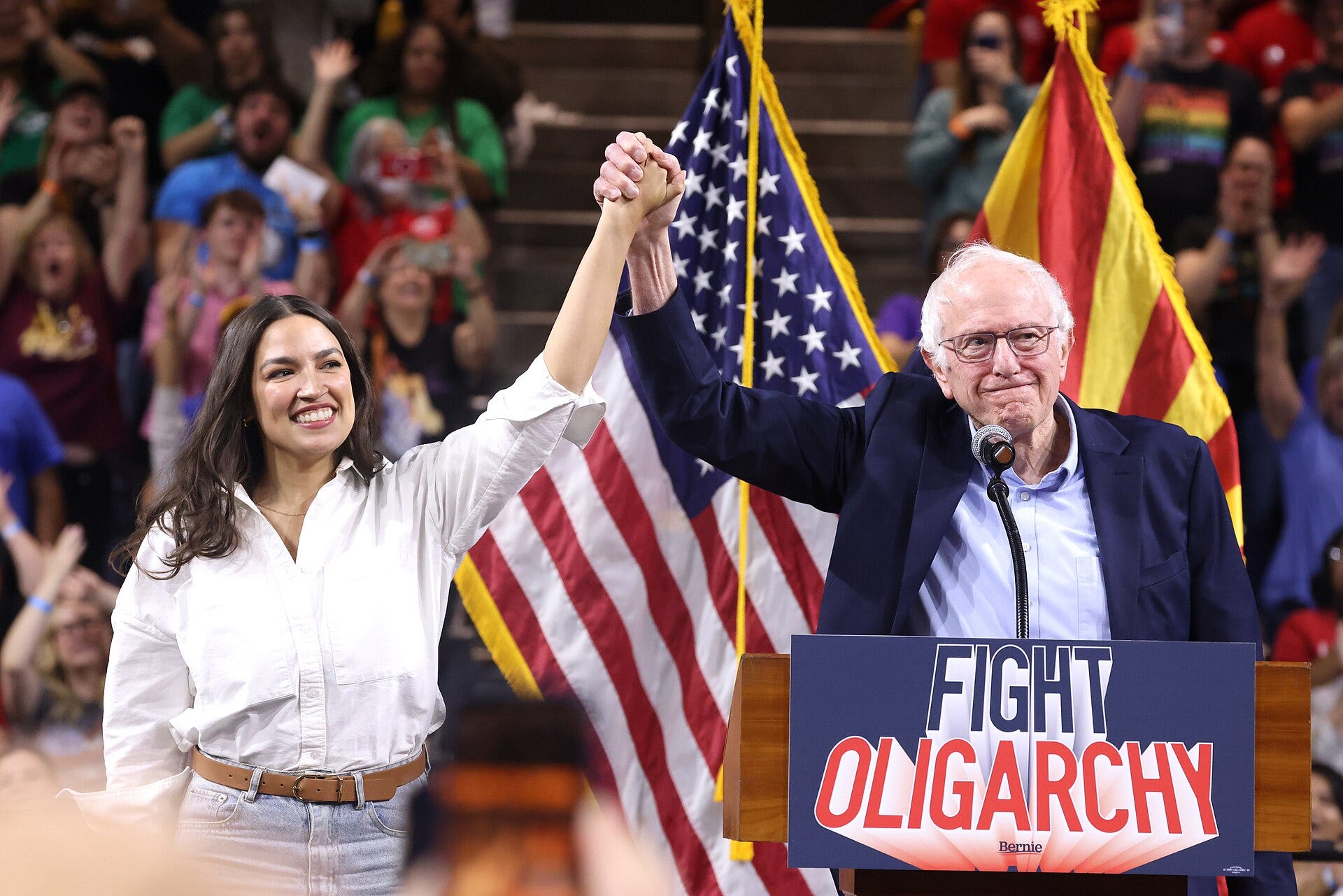
I have always loved the political metaphor of the big tent. The Democratic Party establishment crows about its status as a big tent but is currently in a state of crisis over who belongs inside and who must be cast outside of the flaps.
Media outlets across the land echo the Party’s proclamation: The socialists elected in races in and beyond New York City have no place inside our tent! But what about the tens of thousands of voters who elected these socialists, many ask in response. Are they cast out as well?
Fox News: “They hate America.”
Democratic National Committee (DNC) leadership: “They hate the Democratic Party; they hate capitalism.”
The second appraisal is more correct than the first and more aligned with the views of Democratic voters. According to a Gallup 2025 poll, Democrats had a significantly more favorable view of socialism (66%) than capitalism (42%). A Majority of Democrats also express disapproval of the Party leadership.
Memories of Big Tents
The big tents in my family were the places of hot revival meetings. Many of my relatives were saved by grace under some enormous canvas structure erected in summer Bible camp. They were called by the preacher to come forward and invite Jesus into their hearts. Although a true believer as a child, I never responded to these alter calls. Nonetheless, summer Bible camps did reinforce the message that I was among a chosen group of outsiders.
The dynamics of group boundaries, lines between insiders and outsiders, have been a recurring theme in my research and writing as a psychologist. There is an extensive social psychological literature on group identities as us vs them formations. No Kings Days bring joyous and bountiful displays of us vs them group unity, forged through shared nausea and horror over the Trump regime.
My own tradition of psychanalytic theory approaches in-group and out-group boundaries as a more dynamic process. Psychoanalysts attend to unconscious and often fluid group dynamics. One recurring dynamic involves projection of disturbing internal conflicts onto outsiders. This defensive use of projection, of “we are good/they are bad,” is a normal part of development and political culture. Morality involves making distinctions between the good and the bad. The pathology is in the rigidity and habitual reliance on this defense. Under the reign of Trump, we are living through a case study in how this dynamic works as an extreme pathology, including in what happens when the defense falls apart. The pathology lies in its adaptive failures and the necessity of increasingly psychotic thinking to shore up the defense.
Hysteria and the Democratic Party Establishment
It is well known that hysterics are more fun at parties than are sociopaths. So too, the pathologies of the Democrats are more seductive than those of Trump’s MAGA base. (Free association here: What comes to mind when we hear endless references to Trump’s “base.” Is it because Trump claims to be a successful builder of Big Things with strong foundations? But what happens when the base “cracks”—a source of endless speculation on MS Now and CNN).
Returning to the DNC crisis: Rather than a rigid character disorder (sociopathic or narcissistic), the DNC establishment is more like the neurotic who projects disturbing feelings onto outsiders only in fits of hysteria. Who let them in?, they ask. How did this happen?, they demand. These are the questions of hysterics, based on their tendency to feel periodically flooded with emotions. Hysterics are not as intent on violently policing and punishing outsiders as are sociopaths. The Kamala Harris campaign had the markers of this form of group hysteria in its insistent “joy” and bad-ass girl power, accompanied by passive-aggressive surprise that so many Democrats were outraged over her refusal to speak to Palestinian suffering or the murderous brutality of the Israeli regime.
The Harris campaign exhibited what psychiatrists since Freud have described as la belle indifference, the hysteric’s apparent lack of awareness or concern towards their symptoms. The campaign thought they could simply remove the signs and confine protesters in the back of the Convention Hall and be done with them.
In the current Red Scare afflicting the Democratic establishment, the fear of young socialists with their “energy” and “passion” signals this stance of la belle indifference. The Democratic Party has depended since the 1930s on socialists to tame the ruthless exploitation and profit motives driving capitalism. But the role of socialists in American history is perpetually forgotten by liberals. What follows is what Freud termed the return of the repressed-a sense of being taken by surprise at a phenomenon that appears both familiar and alien.
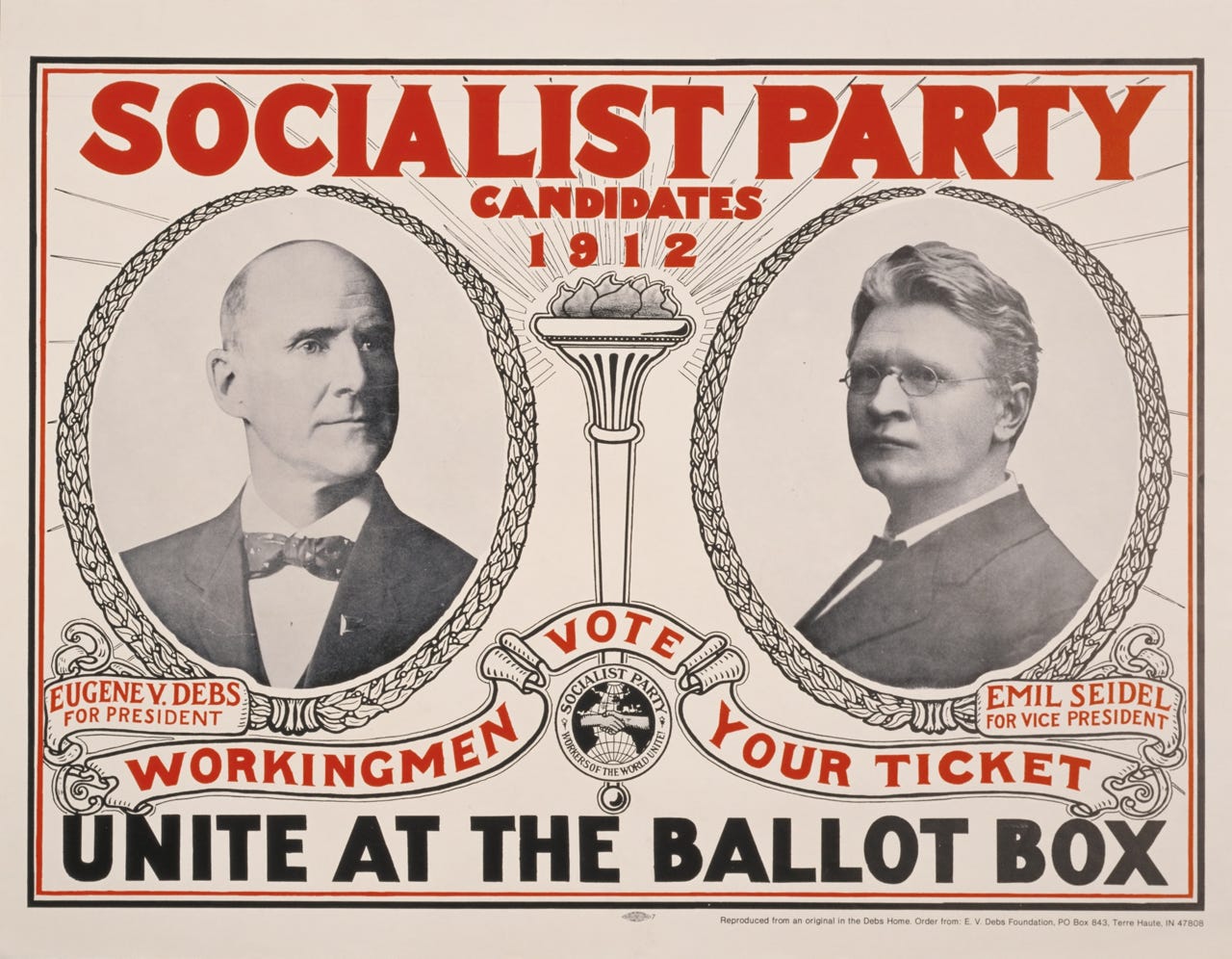
Once forced to recognize the popularity of socialists among many Democratic voters, the DNC establishment scans the members for signs of disloyalty. In remodeling the Democratic Party’s famous big tent, they overlook, as overlords generally do, the variegated terrain outside their own tightly controlled borders. Christians generally know about protestant denominations and historical schisms between Catholics and Protestants. And white Christians likely know a little about the history of the Black Church and the Civil Rights movement. Martin Luther King Day honors this legacy in spite of the Trump regime’s efforts to repress from national consciousness all memory of MLK. School children may still read, however, King’s Letter from a Birmingham Jail. From an African American Southern clergyman, the letter was an appeal to white Southern clergymen:
“I think I should give the reason for my being in Birmingham, since you have been influenced by the argument of ‘outsiders coming in’… In spite of my shattered dreams of the past, I came to Birmingham with the hope that the white religious leadership in the community would see the justice of our cause and, with deep moral concern, serve as the channel through which our just grievances could get to the power structure. I had hoped that each of you would understand. But again I have been disappointed.”
America as Big Casino
MLK Jr lived through the era of segregationist Southern Democrats and had no illusions about big tents. The true size of the Republican Party’s claims as a big tent, however, has always been subject to wild speculation. They did invite in working class white men and Latinos in the last election cycle but many of those groups have since left. Whatever the dimensions in the past, no one would describe the current Republican Party as a big tent today. Indeed, the metaphor does not work at all in capturing this moment. The giddiness of Trump’s Republican Party lies in his Big Casino vision. The President controls the house and we are all losers in this Las Vegas like world of reckless gamblers.
Perhaps that’s why President Trump did not know how to organize a proper Fair at the Capital to celebrate our country’s 250th birthday. Every county in America knows how to plan a fair, even in sweltering heat. These are places that bring city and country people together.
MLK’s Letter from a Birmingham Jail could be sent today to the DNC leadership. King refused to align himself with a theology and politics based on the psychological and political repression of his people.
“The Negro has many pent-up resentments and latent frustrations. He has to get them out. So let him march sometime; let him have his prayer pilgrimages to the city hall; understand why he must have sit-ins and freedom rides. If his repressed emotions do not come out in these nonviolent ways, they will come out in ominous expressions of violence. This is not a threat; it is a fact of history. So I have not said to my people, ‘Get rid of your discontent.’ But I have tried to say that this normal and healthy discontent can be channeled through the creative outlet of nonviolent direct action.”
The creative and non-violent expressions of discontent that mobilize many voters, young and old alike, through democratic socialist and other left candidates are responses to the severity of the crises we face. While the DNC aims to simply steady the ship, these candidates say that such modest adjustments are not nearly enough. They refuse the seductions of la belle indifference.
💬 Share Your Thoughts
What role should dissent, protest, and democratic socialism play within the future of the Democratic Party: a challenge to the establishment, a necessary corrective, or something else entirely?
just watched atomic bamboozled and the fantasyland presentation in china. as a former student i much enjoyed being back in your classroom.
i indeed recall every film strip in elementary school with the same fantasyland narrator boasting every new industrial scale that would descend as a miracle of technology (as well as field trips to both trojan and bonneville, thankfully not hanford that i wouldn't learn of for another decade at the least).
do hope your next deep dive is into the next bamboozle of AI data centers as the threat that will demand that new nuclear energy (and likely takeover the science™️ and production w/3D printing). and the reality of wtf they would be needed as anything but to store the massive data of mass surveillance as the noose around our collective neck!
love what you've gone on to do, Prof Haaken
Yes socialists are a necessary corrective—esp now when a clear-eyed, uncorrupted opposition party is so critical. Way too many Democrats in congress are bought & it seems these newer
socialists candidates are definitely not.