
I’m delighted to speak with the Italian scholar Dr. Claudia Ortu. She is a researcher at the University of Cagliari in Italy. Her work focuses on discourse analysis, and she is also active in pro-Palestinian and anti-capitalist movements. She is part of the Sardinia–Palestine Friendship Association and a member of the Research and University for Palestine (RUP) Network, which advocates for the academic boycott of Israeli universities in Italy.
We met last month at the Al Ard Film Festival in Sardinia. It’s wonderful to continue our conversation after the festival.
You can subscribe to Dr. Claudia Ortu’s newsletter on Substack for more of her work.
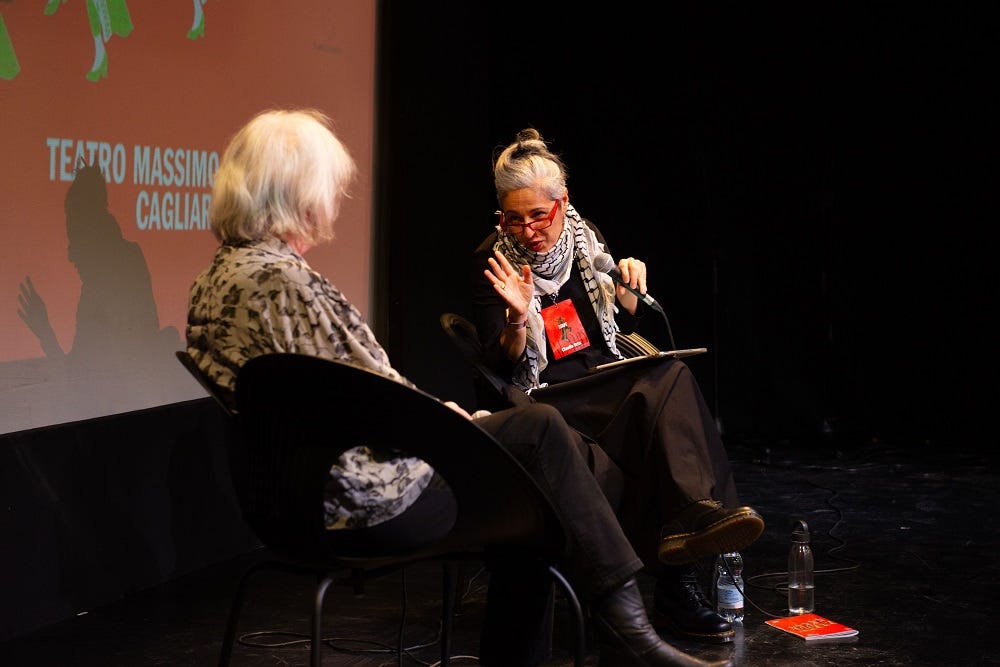
This was one of the most wonderful festivals I’ve attended. You also joined me for the Q&A after the screening of my film The Palestine Exception. Can you tell us a little about the festival and how you became involved?
The festival has been running for 22 years. I initially became involved as a translator and subtitler for the films. I also helped with Q&As conducted in English, since my academic background is in English linguistics and discourse analysis.
Because of that expertise, I’ve always contributed to the linguistic side of the festival—translation and interpretation. But over time I’ve managed to reshape my role as an interpreter making it less technical and hybridising it with that of an interviewer/interlocutor.
Have you seen a blossoming of film culture focused on Palestine as you’ve reviewed submissions this year? It seems like a golden era for Palestinian filmmakers, though of course there is also a long history of cultural work through film. What stood out to you this year?
It is becoming harder and harder to select films, that’s for sure. As you said, there has been a flourishing of creative work about Palestine, and we have seen an increase in submissions both this year and last year.
I should admit something that feels strange to say as a scholar of discourse analysis. I have been losing faith in words lately.
Yes, I know—it sounds crazy. But we use words in every possible way to try to defend Palestinian life and rights, and at the moment it feels as if no word is strong enough.
That’s why cinema can be so powerful. Film brings together images and language, and meaning emerges from their interaction. Communication is always multimodal, but cinema highlights that in a particularly powerful way.
Our societies have become increasingly image-based. Perhaps the “naked word” now needs the support of images in order to reach people—to speak to those who share this moment in history with us.
I was curious about the challenges of translation during the festival, especially in the Q&A discussions around the film. The Palestine Exception examines words and slogans that have become controversial or condemned in the pro-Palestinian movement. Movements often develop slogans as a kind of shorthand speech, but these can later be repressed by dominant powers. How did those ideas translate to audiences in Italy?
That’s a very interesting question. Many of the concepts and slogans explored in your film are actually the same ones that are debated and criticized in Italy.
Take the phrase “From the river to the sea.” In demonstrations here, we often chant it in English rather than Italian. Partly that’s because the English version rhymes with “free,” while the Italian translation does not.
So sometimes we keep expressions in English when they have been adopted by the movement. They become part of the shared language of activism.
The word “Zionism” is another interesting example. Before the events in Gaza intensified, it was mostly used within activist circles. It belonged to a relatively small speech community.
But after Gaza, the term entered wider public discourse. For me, words are like coins—they only have value if people recognize them and agree on their meaning. Zionism has now become a word with broader “currency” in public debate.
People may disagree with you when you use the word, but they understand what you are talking about. And that is an important step.
Were there particular parts of the film that resonated especially strongly with Italian audiences?
Yes. The scenes showing police violence against encampments and demonstrations resonated deeply. Italian audiences recognize that kind of repression.
Police forces around the world increasingly use similar tactics, and many of those tactics have been developed through cooperation with Israeli security institutions.
Exactly—and that includes surveillance technologies as well.
But also the methods used to control crowds and suppress protests. Many activists argue that tactics first tested on Palestinian bodies are later used elsewhere.
This is why activists often say, “We are all Palestinians.” It is not just a symbolic statement. Palestinians are often on the front line, where certain forms of repression are tested before they spread globally.
So their struggle becomes connected to struggles elsewhere.
One of the things I noticed while making the film was how many young people identify with the Palestinian cause. They see connections between settler colonialism, capitalism, racism, and other systems of oppression. They are horrified by the violence but also inspired by Palestinian resistance. Is that something you see in Italy as well?
Definitely.
You reminded me of an idea discussed by the scholar Saree Makdisi in the film: oppression exists because there is resistance. Oppression is a response to people refusing to submit.
Palestinians refuse to accept a life reduced to mere survival. Because they refuse, they are punished.
The same dynamic appears elsewhere. When people refuse to live only as consumers or producers within a system—when they say, “I am a human being with ideas and principles”—that challenges the system.
Students demonstrated this very clearly. They said: “My career is not the most important thing. My humanity is.”
That is something the state and the economic system struggle to tolerate. They prefer individuals who only pursue personal success within the existing structure.
When people insist on being human beings rather than cogs in a machine, that becomes threatening.
I’d like to conclude with a quote from the Marxist cultural theorist Antonio Gramsci, who was from Sardinia. His famous line reads: “The old world is dying and the new world struggles to be born; now is the time of monsters.” He wrote this while imprisoned by Italian fascists. How does that quote resonate with you today?
Yes, that quote—about the “morbid symptoms”—is very well known here.
I’ve actually used it recently in an article I wrote about the criminalization of protests. In Sardinia alone, 79 people are currently under investigation for participating in demonstrations.
So I wrote that these prosecutions are exactly what Gramsci described: the “monsters” that appear when the old world is dying but refuses to disappear.
The system senses its own decline and reacts violently in order to delay that process.
But we must remember the other side of the quote: the new world struggling to be born. Our task is to organize so that this new world can emerge.
And in many ways, we are learning from Palestinian resistance. Resistance can take many forms—from students pursuing their education despite everything, to mothers caring for their children, to people simply insisting on their right to dignity.
All of these are forms of resistance.
So the key word for me is organizing. We organize so that the new world can be born.
And perhaps, continuing your metaphor, there are many midwives helping to bring that world into being.
Exactly.
Thank you so much for joining me today, Claudia Ortu. It was an honor to present The Palestine Exception at the festival this year, and please extend our solidarity to your colleagues and comrades.
Thank you.

The Palestine Exception is a searing and unflinchingly honest account of what it means to stand for something, and the immense consequences of speaking up. This is a vital documentary for our present moment, but also a terrifying look at how institutional power has always tried – and will always try – to enforce silence on every last one of its critics.
Omar El Akkad, author of One Day, Everyone Will Have Always Been Against This. Winner of National Book Award

▶️ Now Available for Streaming on Kinema
I’m excited to let you know that SUMUD is now available for streaming on Kinema.
The stream also includes the full panel discussion recorded after our premiere. The conversation is candid, searching, and deeply personal. We talk about what it means to document suffering ethically, about the burden carried by medical workers who return home, and about why storytelling still matters.
The stream will be available to watch anywhere in the world - with a suggested rental of $4.99 and a pay-what-you-can option.
🎥 Free Screenings for Teachers, Community Organizers, and Groups
For teachers, community organizers, and groups, SUMUD is also available directly through our website for educational screenings. I have long believed that films do their deepest work in shared spaces - in classrooms, union halls, community centers - where difficult conversations can unfold collectively.
We are making the film available free of charge to activist organizations and educators.