

Many people are losing their religion these days. MAGA followers are leaving the Trump cult, Dems and independents are abandoning DP corporate leadership, young Evangelical Christians are questioning the fanaticism of their elders, those stalwart defenders of Israel who also preach their End-times vision of Jews cast into the ovens of an everlasting hell.
In this piece, I take up conversations with Jewish students who have stunned their elders by turning against liberal Zionism.
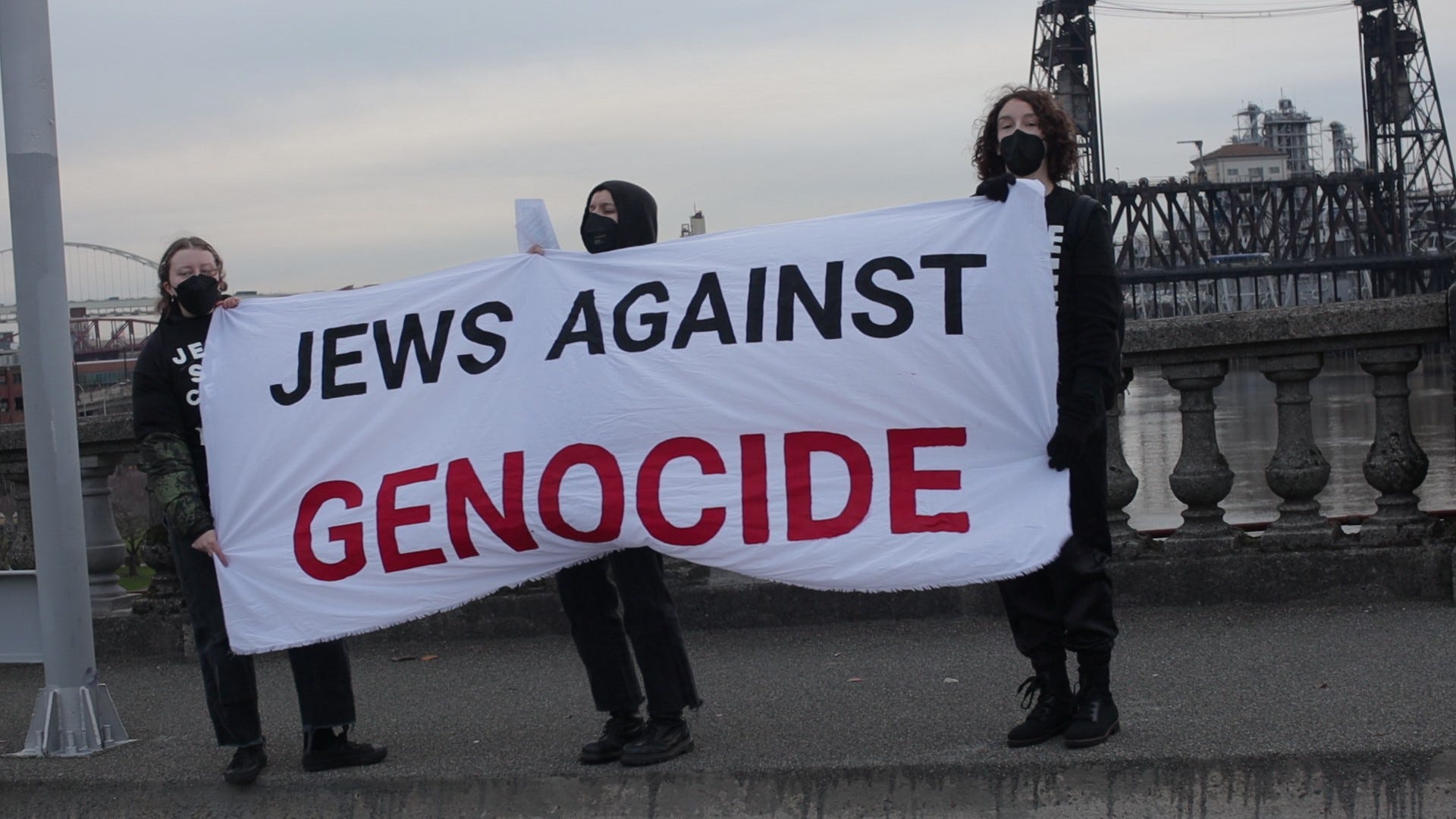
In over a hundred screenings of The Palestine Exception over the past year and a half, I have talked with countless students. A number of these students organized actions and teach-ins during the 2023-24 academic year and faced the crushing responses of their school administrators. Jewish Voice for Peace (JVP) chapters were particularly active in organizing screenings of the film across the country and Jewish students played important roles in support of Palestinian-led protests.
Rather than trauma reactions, many of these students were expressing what I came to see as a certain crisis of faith. It was not so much a crisis of religious belief than one centered on what they found to be the moral lacunae of admired elders.
Protecting ideals and holding valued images of people are important to character development. In the face of attacks on those ideals, defensive responses are also part of acting on moral conviction. But these situations can be most agonizing when ideals—someone or something dearly loved—comes to be looked at in a new light. (In my own early adulthood, I struggled with a similar conflict with new disturbing understandings of family history. Cherished stories of my godly grandparents leaving Minnesota to homestead in the harsh conditions of Frog Lake, Alberta were difficult to cherish in the same way when I learned how my grandparents got that land and the genocidal starvation of the Frog Lake First Nations people.)
For many Jewish students, many who were never spanked as children, this crackdown on their campuses was an affront to cherished representations of parental figures, including the liberal leaders of their schools. Questioning various Israeli leaders, including Netanyahu, was permitted in many of their households and synagogues. But students were violating a taboo when they pointed to the injustices behind the entire Zionist project. They could defend the (perpetually deferred) two-state solution. But they could not question the necessity or morality of Israel as a sanctuary for the Jewish people after the Holocaust.
A good liberal arts education inevitably generates discomfort—and for some, existential crises--as students ask new questions and enlarge their understandings of the world. For the majority of campus protestors, speaking out against the genocide in Gaza meant acting on a key principle of their liberal education.
In the Q and A post-screening discussions, students often asked me to respond as a psychologist to their distress as well as from my perspective as a film director. Palestinian students, as well as many Black and brown students, were less shocked by the brutal responses of their administrators to the protests than were Jewish students. Palestinians tended to view the Hamas October 7th attack on Israel in the context of decades of apartheid and systematic violence against Palestinians.
For many Jewish students, the genocidal assault on Gaza stirred the post-Holocaust cry of “Never again!” Their chants extended that line to “Never again! Never again for anyone!”
This linguistic extension of a moral call struck at the heart of a painful contradiction in liberal Zionist politics. As “Never again for anyone” mobilized protestors, the chant felt to many Jewish students like the breaking of a taboo passed on from their elders. And once broken, the taboo no longer held things in check in quite the same way. The violence of the crackdown registered the very failure of the taboo. Doubling down on the enforcement of a taboo with violence may produce public submission. But it as likely produces private rebellions.
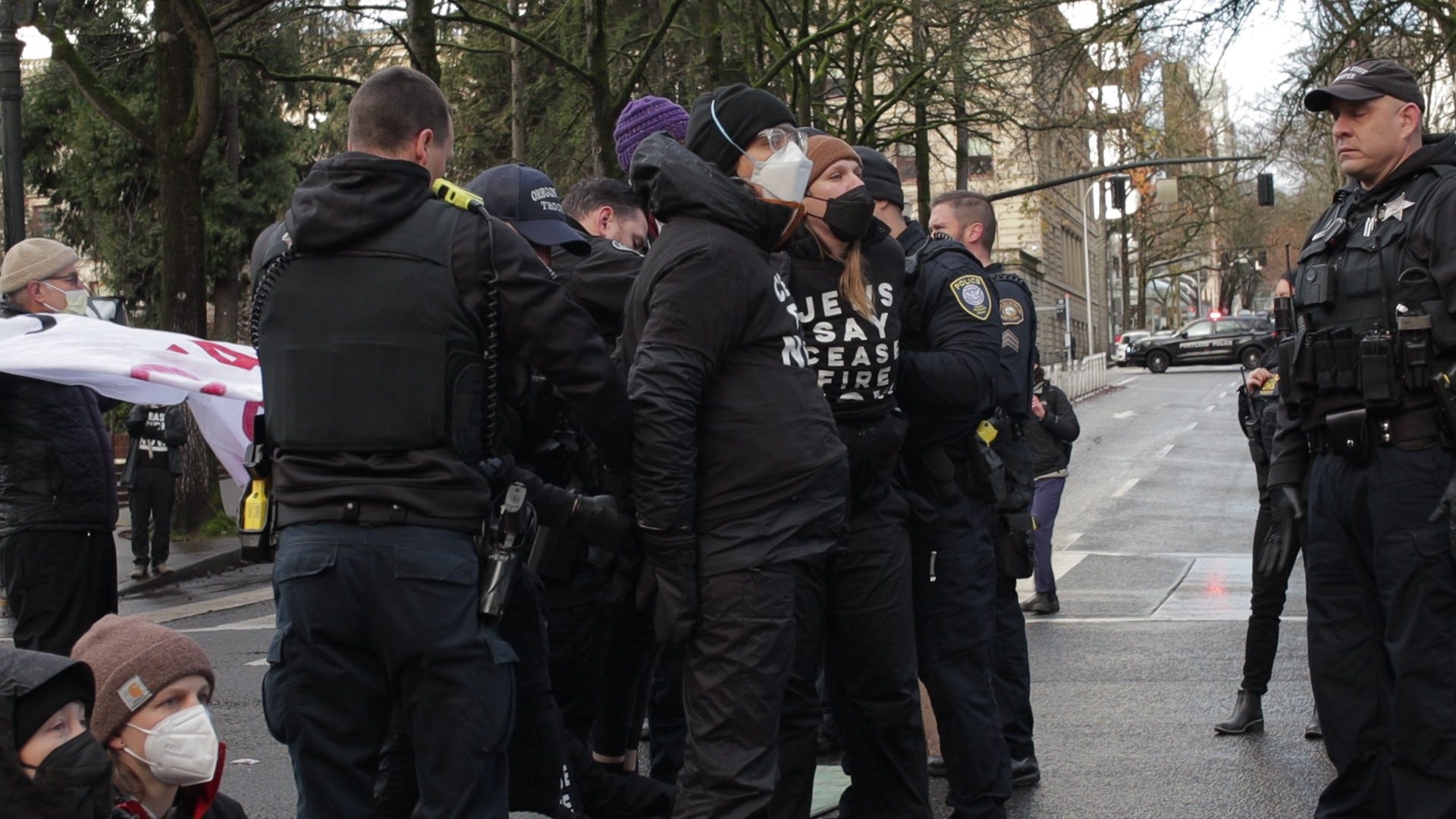
In addition to the meaning of slogans such as “From the river to the Sea, Palestine will be free” and “Globalize the intifada,” the contested meaning of “Never again” emerged as a touchstone topic in The Palestine Exception. In the film, UC Berkeley professor Judith Butler takes up the lessons of the Holocaust and explains that “It’s important to remember that people who have suffered tremendous oppression can also inflict tremendous oppression.” Students witnessed the federal government’s adoption of the International Holocaust Remembrance Association (IHRA) definition of antisemitism, which designates criticism of Israel as a form of antisemitism. This definition was legally imposed on universities under the Biden administration under Title VII antidiscrimination laws and became the legal fist accompanying the boots and tear gas. Not lost on Jewish activists was the absurdity of this charge of antisemitism. Under Trump 2.0, the deployment of federal law under the ruse of combatting antisemitism accelerated as universities caved to appease the new regime.
In some of those Q and A discussions, students struggled with conflicts among various campus groups as well. As in all social movements, factions develop with different ideas about strategy and political analysis. On some campuses, establishing encampments with “No Zionists allowed” represented the refusal of the old virtuous shibboleths of liberal Zionism.
Jewish student activists in the US were confronting the contradictions between traditions of Judaism that fought for civil rights in the US and a secular state against Christian nationalism, on the one hand. On the other hand, those same traditions were defending a state based on Jewish supremacy and denial of Palestinian rights.
Exposing that contradiction in American Judaism and the repressed history of the Nakba sometimes led to erecting rigid boundaries around the encampments. Some Jewish students filed complaints over these restrictive spaces. Movements inevitably include such defensive reactions and sometimes over-reactions.
For directors Jennifer Ruth and me, documenting what was at stake in the campus protests from fall 2023 through fall 2024 was a way of paying tribute to this movement. In the midst of media demonizing of protestors, law enforcement crackdowns and university disciplinary actions, we wanted to show that these students were on the right side of history. When we filmed at Hunter College/CUNY and Barnard/Columbia University in early 2024, pro-Israel demonstrators, flanked with police support, were in full display. Yet echoes of earlier anti-war movements and social justice struggles were palpable. The city carries a rich history of progressive political actions that ignite national movements, from the 1969 Stonewall uprising that launched the gay rights movement, the 1980s student organizing against Apartheid in South Africa, Occupy Wall Street in 2011 that inspired the national Occupy Movement to the first pro-Palestine encampment at Columbia in spring 2024.
Zohran Mamdani, a Muslim American, made justice for Palestine a central plank of his mayoral campaign and won with a wide margin of supports, including among Jewish New Yorkers. Beyond New York, majorities of Americans, and particularly among Democrats, came to the same position as that fought for by these brave students.
🎙️ Left & the Law
In our Left & the Law segment on KBOO Community Radio this month, Mike Snedeker and I look back on the student protest movement in light of dramatic shifts in public opinion.
Join us on the Old Mole Variety Hour on KBOO Community Radio and listen to the full Left & the Law segment!

💬 Share Your Thoughts
What impact do you think the student campus protests had on the public opinion and politics around support for Israel?
I am most concerned with how, and how much, the university student encampments and other protests have impacted Jewish institutions and leaders in the United States. My pessimistic guess is: not much. (I would love to be wrong.) As examples: do most synagogues (especially otherwise "liberal" synagogues) still keep the Israeli flag in pride of place on the bima? Are there discussions and book clubs in synagogues or other communal organizations of Palestinian history, the Nakba, anti-Zionism, etc.? How has programming in the JCRCs and Jewish Community Centers changed, if at all, with regard to Zionism, support for Israel, and related issues? Are openly anti-Zionist Jews welcome as members or employees? Since universities are somewhat set aside from the rest of society, Jewish and secular, I have a sense that these protests did not much disturb the ongoing work and planning of these organizations, despite upsetting the leaders/donors/members EMOTIONALLY. As a formerly religiously observant Reform/Renewal Jew, now deeply alienated, I have a sense that you may be underestimating the extent to which formerly (at least somewhat, for major holidays) young Jews have turned away from their religion, despite the efforts of Jewish Voice for Peace in this regard.