

Queer Pride, the Quiet (Trans) and the Loud (Drag)
There is a blunt edge to attacks in the US on LGBTQ+ people and their rights. At the same time, attacks are expressed in sharply differentiated ways.
State laws proposed or passed in recent years include everything from bathroom bans and restrictions on gender-affirming health care to laws against drag performances and campaigns to overturn gay marriage. These repressive campaigns share a common political agenda. But they each express specific anxieties and defenses animating conservative politics.
Generational Shifts Within LGBTQ+ Identity
There are important generational dynamics in play as well. While many women of my generation fought to come out as lesbians (L), many young women identify as queer (Q) or bi (B). These latter terms reflect the gender fluidity that is central to this generation’s politics. These politics also reflect younger activists’ emphasis on the irreducible remainder of non-conforming categories (+). Gay (G) is still an umbrella term. But the G remains troubling to some straight people in its association with gay men and anal sex. Lesbians in the homophobic imagination can be pictured as cuddling in non-genital ways. Gay men, on the other hand, bring to mind images that disturb more forcefully repressive hetero-sex codes.
Marriage Equality and Civil Rights
The advances in LGBTQ+ rights are important to celebrate even in waves of backlash. Gay marriage gained broad popular support in the 21st century with most Democrats and around half of Republicans supporting same-sex relationships (with regression in support among Republicans under Trump 2.0). The right to marry in the US across race (interracial marriage was illegal in the US until the Supreme Court 1967 Loving v Virginia ruling of June 12, 1967) and gender lines does represent real progress. It is important to honor and learn from the movements that fought for this basic civil right. At the same time, the right to marry represents the most domesticated and conservative demand of the gay rights movement. Gender fluidity (and the famous Trump ad against Harris, “She is for they/them; He is for you”) mobilizes old fears around a new frontier of perceived threats (+!)
LGBTQ+ people share many of the same experiences of oppression. At the same time, the anxious gaze of the bigot brings differing thresholds of threat to its persecutory campaigns. Homophobic hysteria is broad and undifferentiated. Hysteria operates as an emotion of refusal, a reaction tied to diffuse sexual anxieties. Political paranoia centers on preoccupation with hidden threats, with differences, driven by impulses to punish. The hysteric draws protective borders. The paranoiac’s concern is with the violent policing of borders.
Drag Queens and the Politics of Visibility
Drag performers are the loudest and most visible side of the gay rights movement. These performances have gained public followings over the years, leading Pride marches and other civic events as well as invited performances in liberal parts of the country for school-age children. The Stonewall Uprising in 1969 was led by drag queens who resisted a police raid on a gay bar in Greenwich Village. The uprising on June 29th of that year is a primary reason that June is celebrated as Pride month. Their insistently joyful visibility makes them an ongoing target of hysterical reactions.
Trans People and the Politics of Suspicion
Trans people, on the other hand, are objects of the aggressively paranoid edge of the right. Political paranoia, much like clinical paranoia, fixates on hidden threats. Its concern is with intimate invasions and alarm over outsiders passing as “one of us.” Post-war McCarthyism marshaled anti-communism through this tactic. A communist could be your normal-seeming neighbor. Or it could even be your doctor. The Trump regime’s violent campaign against “aliens within” is awash in the markers of the crazed paranoiac: “They walk among us,” the government website ominously declares in shades of horror comic green.
In an article and prelude to Gender Trouble, published the following year, queer theorist Judith Butler offers an astute observation that touches on this same distinction (even as she conflates transvestism and drag):
“The site of a transvestite on stage can compel pleasure and applause while the site of that same transvestite on the seat next to us on the bus can compel fear, rage, even violence.”
Put in contemporary terms, the drag queen on stage can be enjoyed as an act (it’s not real, after all) whereas the trans woman’s claim to a place in everyday life feels dangerously close.
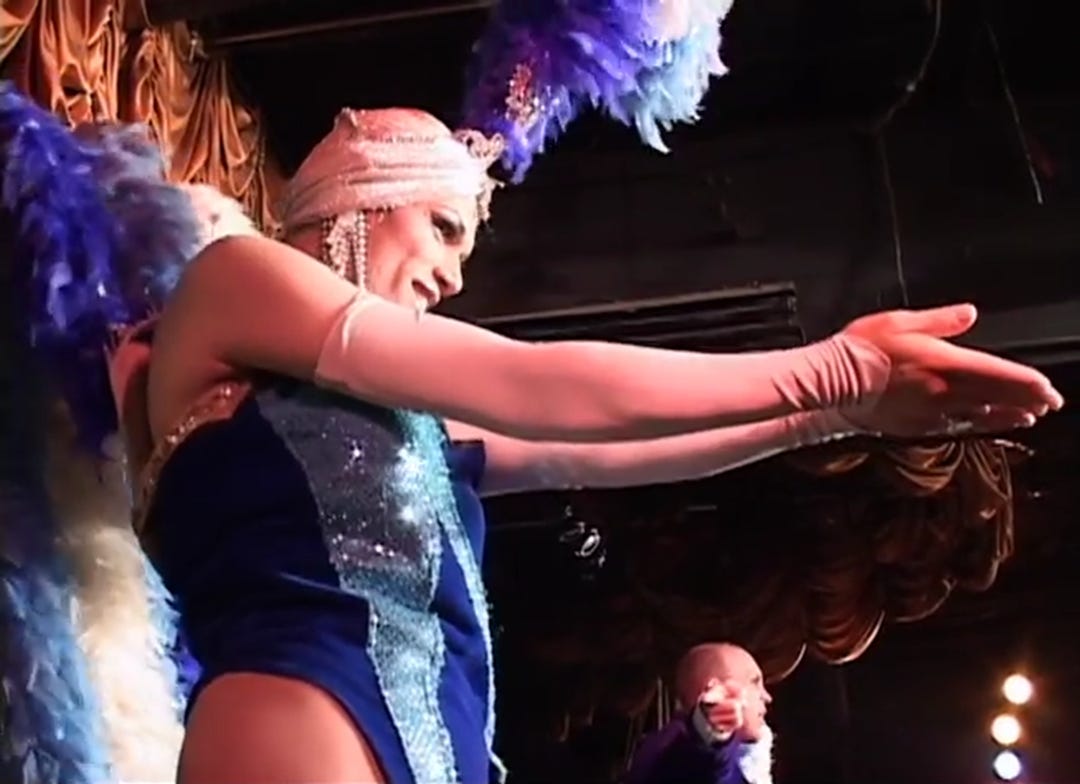
In my earliest documentary feature, Queens of Heart: Community Therapists in Drag, Darcelle XV, the star of the film, takes up different identities and the meanings of those identities in the LGBTQ community. She explains the difference between gay men performing drag and trans women just living their lives and also comments on public conflation of cross-dressing—a private practice primarily of straight men—and drag, a very public performance primarily by gay men. We learn in the film about the history of the club as a lesbian bar in the late 1960s and as a refuge over the decades, including during times of intense persecution. The club has been most famous locally for their raucous “bride’s last night out” parties—a phenomenon that we take up in the film.
Drag, Gender Identity, and Community Tensions
The documentary project began in 2003 with conversations in the LGBTQ community, including currents of ambivalence for some about drag. In a conversation on Reddit in 2023, two decades later, I was reminded of these early conversations, and particularly comments by trans women about drag queens.
“It gives me a huge amount of dysphoria. It is like my worst fear. That I will always look like a guy in a dress.”
“Yep, this is why. Drag is what (almost) every trans girl is afraid of being.”
“I don’t have a problem with drag queens…but I do have a problem being called one….I want to be a girl. I want to feel like a girl and be perceived as a girl….not as a guy playing dress up.”
This Pride Month, it is important to march in solidarity with a movement that carries liberatory potential for all of us. At the same time, it is important to recognize how attacks on people take varying forms. Each identity in the LGBTQ+ Rainbow is its own Rorschach card for bigots, arousing fears, fantasies and persecutory impulses that we must collectively resist.
Remembering Darcelle XV
Portland Oregon is a queer friendly place for the most part. In this city, we honor this month the memory of Darcelle XV, our city’s most famous and beloved drag queen. At 85 years of age, she was proud to receive an entry in the Guinness World of Records as the oldest continually performing drag queen in the world. With support from her rhinestone encrusted walker, she continued to delight audiences with her dazzle, warmth and acerbic wit until shortly before her death at age 92. She was my friend and a friend to so many others.
Goddesses rest her beautiful soul.
Watch Queens of Heart Free on YouTube
