

Through my work as an academic and clinical psychologist, I have spent much of my career reporting on allegations of sexual misconduct, including in cases of campus rape. Over the past eight years, I have served as a grievance officer–a volunteer position—with the Portland Chapter of Democratic Socialists of America (DSA). In that role, I have investigated a number of cases involving claims of sexual assault. These investigations include supporting survivors as well as preserving due process for the accused.
As posts flood social media in support of Jane Doe in her Cornell University lawsuit (#Iamjanedoe), I want to weigh in on a few aspects of this case that stood out to me. I also want to show how the lawsuit, in spite of how outrageously and depressingly familiar the case might be, is in part a document of feminist progress.
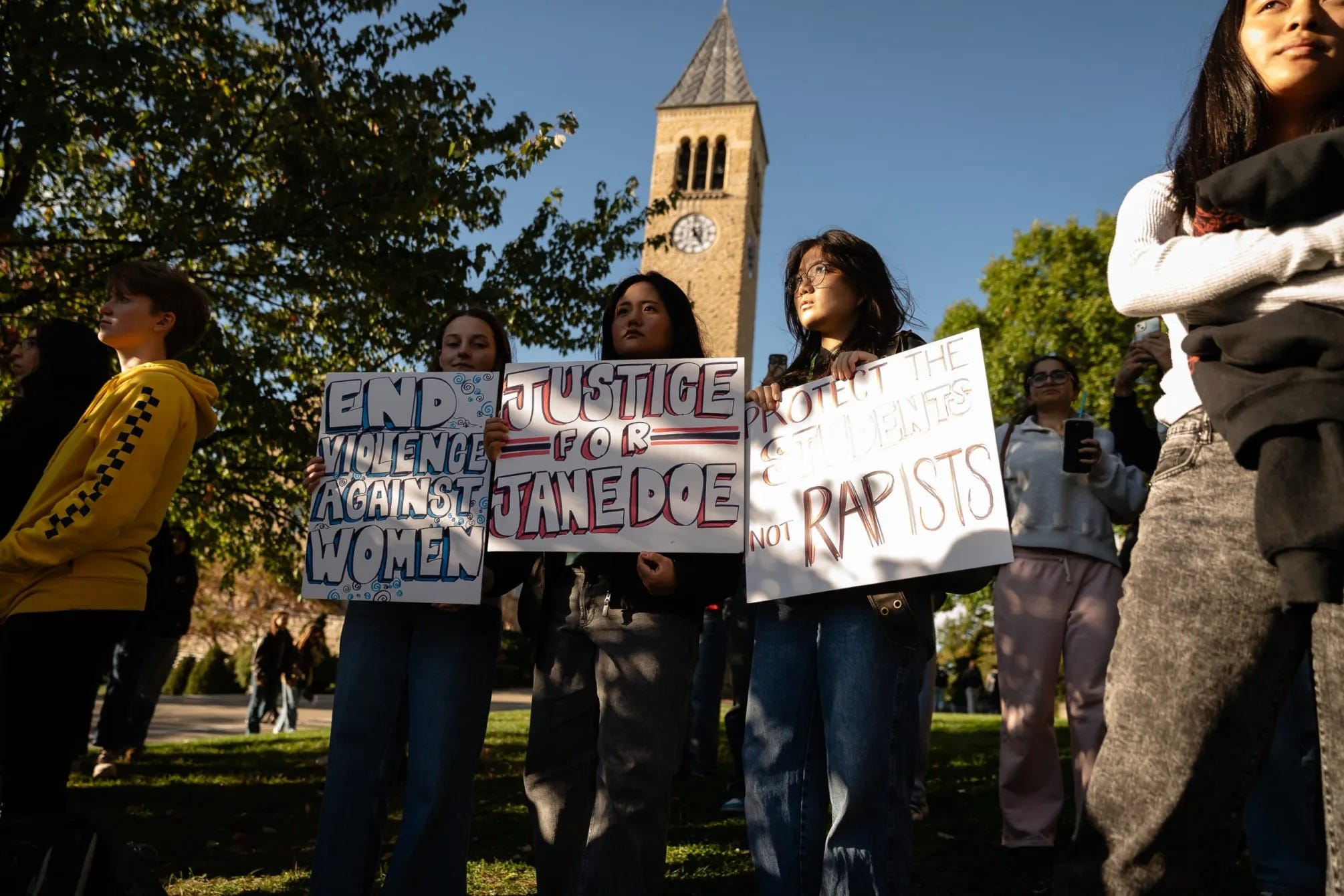
Jane Doe v. Cornell University, et al
At a campus police department on Nov. 14, 2024, a 20-year-old Cornell University sophomore detailed how she found herself naked in a fraternity house nearly a month before, with a “ring of men” around her. She was drunk and had been given ketamine, she said. Her phone was across the room. The woman told the officer that what began as a consensual sexual encounter with a man she liked and his fraternity brother spiraled into a prolonged drug-fueled attack over many hours with several other men inside the Chi Phi fraternity house. The Cornell police informed the local DA’s Office of their investigation in this case and asked the DA to review a statement they submitted signed by the student to determine if her allegations constituted a crime under New York law.
This student is now widely known as Jane Doe through the civil lawsuit submitted by her attorneys on September 16, 2026 against Cornell university, its Ch Phi fraternity chapter, seven student members of the fraternity and others. Doe alleges that she was drugged and gang-raped by the seven students at the Chi Phi fraternity house in 2024, and that Cornell failed to protect her and punish the alleged perpetrators. She seeks a jury trial for damages.
According to her lawsuit, Doe had already consumed about 10 standard drinks within the past three hours when she arrived at the fraternity house. The complaint alleges that the friend and another fraternity member with whom she initially agreed to have consensual sex began to give her more alcohol and to pressure her into snorting a substance they described as ketamine, and that she was then sexually assaulted while incapable of consent. She describes being afraid, hiding under some covers and being sexually assaulted for hours before being taken back to her sorority house in the morning.
Defendants in this case do not dispute what happened at the Psi Chi fraternity. The defense centers on whether Jan Doe consented to the group sex and on the process of the investigation after she reported to the campus police.
Perhaps most revelatory is the Snapchat that one of the men circulated at 1:45 am to other Psi Chi members. Its validity has not been disputed. Among the posts: “Free pussy in alum pu (pop up, to start a chat),” “Free,” “Like you can walk in and whip it out,” “I fuckin love Psi Chi.” There were no posts from Psi Chi members expressing concern or moral outrage over what was happening.
Group Dynamics
A key insight of second wave feminism and women’s organizing around campus rape was to bring group psychology into our analyses. In challenging the prototypical image of the lone dark alley rapist, feminists showed how male bonding and initiation rites often involved symbolic or actual acts of sexual violence. In response, anti-rape work must be taken up as a group project. “Take Back the Night” actions, for example, involved turning to other women for safety in re-claiming the streets. We looked to each other for escorts and made sure our friends were not left behind at parties.
Rather than turning to husbands, fathers, brothers, boyfriends or the police for protection, Take Back the Night meant insisting on our right to enter spaces considered dangerous, places where women were forbidden entry.
Black feminists remapped those landscapes, showing how white supremacy, racial violence and policing intersect with the dangers of the streets and the differing threats women face. Black women faced racial violence that intersected with their sexual victimization. Patricia Hill Collins describes the American cultural history of Black women cast as “Jezebels”—as hypersexual, seductive and immoral.
One of those threats refracting along gender, race and class lines centers on patriarchal thinking in separating the “good women” worthy of protection (the virtuous wives and daughters of white men) from the “bad women” (sluts, prostitutes, whores, Jezebels) who deserve whatever bad treatment they get. The Psi Chi Snapchat reflects the category that Jane Doe found herself: a commodity to be used and discarded after the party.
Feminists fighting sexual assault have long recognized that “believing women” is not as simple as the slogan might suggest. What might have begun as adventurous sexual exploration with cool older boys can turn ugly in ways that feel confusing. Most people try to hold in mind the good in people that can coexist with destructive capacities. One way of preserving an image of an idealized figure as good is to take upon oneself the position of the “bad” in the scenario. Patriarchal codes have always placed responsibility on women for failing to stop the sexual transgressions of men.

Doe’s roommates told the school’s investigators that she arrived home around 11:15 am the morning of Oct. 20, still wearing her “big boots and small dress” from the night before, according to the documents obtained by the New York Times. Doe reportedly told her roommates she had taken ketamine and had sex with multiple men. A roommate told investigators that Doe appeared to be “in shock” and was “not really understanding the gravity of what she was saying.” Another roommate told investigators that Doe had not yet used the words “rape or assault.” Doe reached out to her big sister at Cornell’s Tri Delta sorority and said word swirled on campus that she was a “slut.”
According to the report, Doe’s roommate helped her to recognize what had happened to her was rape rather than that she was a bad person. In online discussion of her reported consensual sex with two men at Chi Phi fraternity in a threesome, there is perhaps a measure of social progress. The boundary of slutiness—at least for many white women students–seems to be drawn as the number of sex partners increases as well as the dangers of the drugs (ketomine vs pot) and the level of aggression involved.
Cornell and Campus Activism
Unlike most of the lawsuits I have seen on campus rape cases, the Jane Doe narrative includes the history of feminist organizing around the Greek houses on campus.
The story begins with her arrival at Cornell as a freshman in 2022:
“In August 2022, Plaintiff was 18 years old when she flew across the country from her family home to begin her studies at Cornell University (the “University”), with similar hopes, expectations and trepidations of other high school graduates embarking on something so seemingly monumental. She arrived on a campus where the University actively promoted Greek membership as a “vital” part of the campus community and endorsed these organizations as well-managed, worthy pathways to new friendships and improving one’s educational and professional opportunities. Large fraternity and sorority houses were in prominent locations on campus.”
The lawsuit lays out some of the history of sexual violence at fraternity parties that was well known to Cornell administrators. “In November 2022, Cornell’s campus police issued alerts that a female student was sexually assaulted and at least four other students were drugged at off-campus fraternity parties.”
It is worth reading the lawsuit as a feminist indictment of rape culture.
“Before and when Plaintiff set foot on campus, she never knew that the University had been the scene of numerous incidents of sexual assault and rape in the months and years prior to her arrival. Students were afraid, protesting, and demanding reforms.
These reforms took place after Resolution 34 was passed in on March 19, 2021, requesting that ‘Cornell University review policies and action items over fraternity system, including reform, disband or abolish’ and have the ‘Office of Sorority and Fraternity Life to perform a yearly review of all fraternities and any fraternity accused of sexual harassment will be placed on probation or have its recognition revoked.’
Even still, in the following Fall 2022 semester, Cornell University saw at least 5 reported cases of drugging and 2 reports of sexual assault on Cornell’s campus, all of which occurred at fraternity addresses. This triggered a response from the Cornell University Student Assembly who presented Resolution 16: Condemning Greek Life on December 1, 2022.
National fraternities and sororities and their executives knew that fraternity chapters and members were incapable of responsibly managing the provision, use and misuse of alcohol and drugs in fraternity houses, during recruiting, and at Greek-sponsored events. One fraternity executive and industry leader confirmed that 99% of insurance claims were related to the misuse of alcohol. Fraternity recruiting events with alcohol would eventually be labeled by another fraternity executive and industry leader as being the ‘deadliest nights.’
Further, Plaintiff was also unaware that a President of Psi Upsilon at Cornell University, Wolfgang Ballinger, was charged with first-degree attempted rape, first-degree criminal sex act with a helpless victim, and sexual misconduct after raping a female student at his fraternity residence in 2016.”
The suit goes on to describe the history of calls by students at Cornell to ban the houses. In 2020, campaigns on college campuses began to address the connections between racism and sexual assault in the Greek houses in elite schools. In the wake of the #MeToo movement and the Black Lives Matter movement, which documented histories of white supremacy associated with fraternities and sororities, a number of private colleges banned or phased out Greek houses on campus.
“During this period, a loose coalition of student activists began a movement known as the Ban Greek Life or Abolish Greek Life Movement which gained significant momentum in 2020 and continues to present.”
“However, despite the Abolish Greek Life Movement and all the bad press that fraternities and sororities had been receiving in the media since the early 2000s, upon her arrival at Cornell, Plaintiff immediately encountered a glorified – yet materially false and misleading –façade of Cornell University Greek life.”
On most college campuses, freshmen meet rows of tables and signs on the Quad describing the clubs and activities available for connecting with other students and the campus community. Students may be assigned to dorms based on shared interests with roommates as well. Greek houses dominate these spaces in “rush week” in ways that appeal to elitist ideas of belonging. In contrast to the housemates of college dorms, Greek houses describe their groups in the familial vernacular of sisters and brothers.
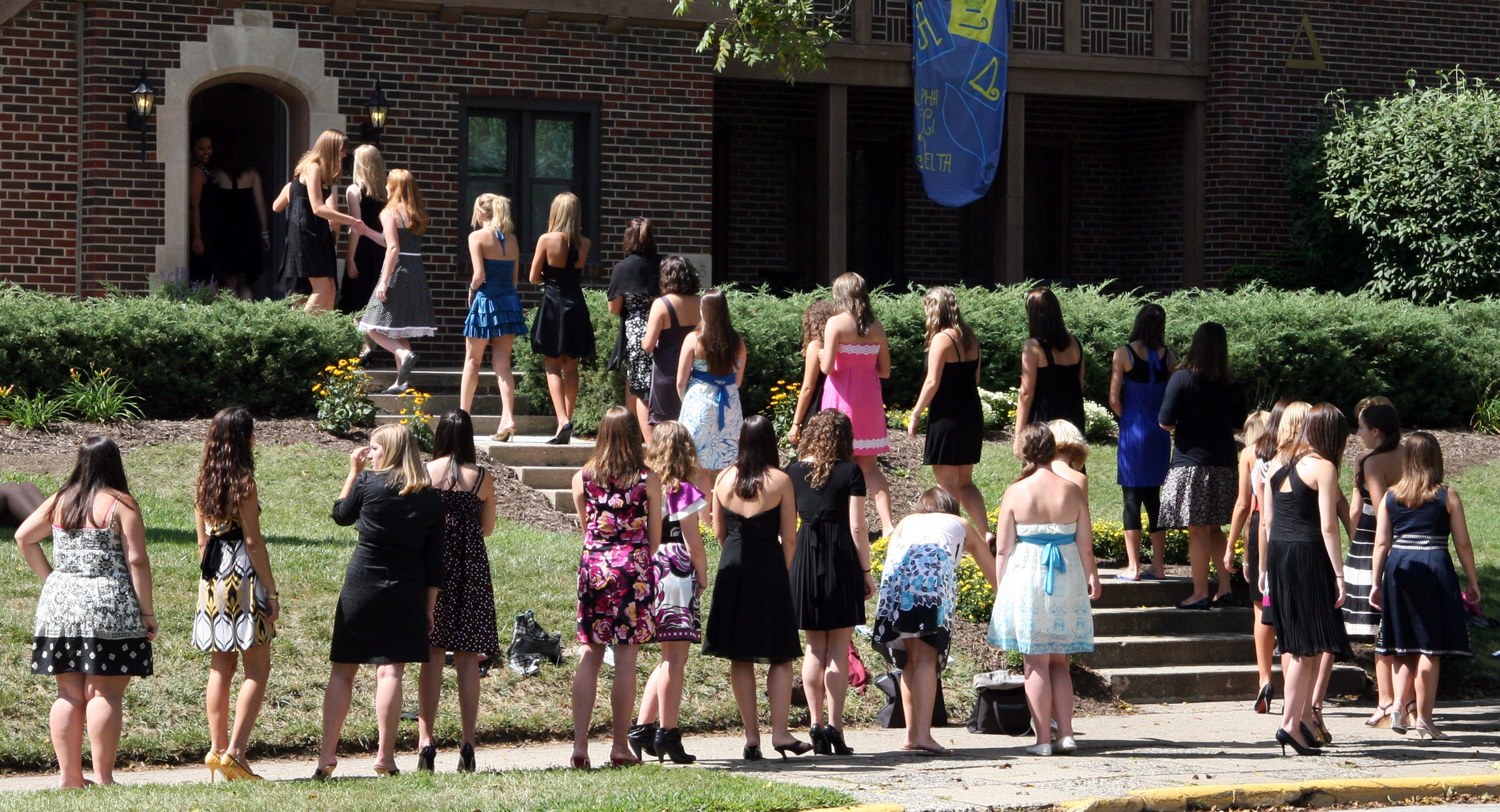
Social movements also enlist the sororal and fraternal in describing forms of solidarity.
Sororities and fraternities, however, initiate members around politically and psychologically regressive rituals of group bonding. As the Greek Life magazine proclaims, “One of the core principles of fraternities is brotherhood. Pledgeship helps new members form deep, lasting connections with their fellow pledges and active members. A strong bond is developed through shared experiences, challenges, and traditions, reinforcing the fraternity’s unity and camaraderie.” The Jane Doe case describes one such ritual of fraternal bonding.
A 2014 The Century Foundation article by Clio Chang, titled “Separate but Unequal in College Greek Life,” reports on the role of the Greek system in promoting racism and other systems of inequality. She cites Cornell University as a case example: “One only needs to browse the Greek life section of Cornell’s official website and see the slogan ‘The Power of 2%’ to recognize the perks that come with Ivy League admittance and Greek acceptance, especially when it comes to men.” [Cornell removed the original page. The link now leads to a cached version.—Ed]
Chang further explains that “while only 2 percent of America’s population is involved in fraternities, 80 percent of Fortune 500 executives, 76 percent of U.S. senators and congressmen, 85 percent of Supreme Court justices, and all but two presidents since 1825 have been fraternity men, according to Cornell. Statistics also show fraternities and sororities spawn incredible opportunities in networking for their members.” They are also among the biggest alumni donors.
The Case for the Defendants
The defendants in the Jane Doe case include seven individuals and a number of institutional parties. Legitimate concerns have been raised about due process and the rights of the accused fraternity members. The public statements by lawyers for the accused include two major points: 1) Jane Doe consented to what happened on October 24, 2024 and 2) that their clients were not directly involved in the events. There may indeed be different levels of culpability or direct involvement in this case.
However, group dynamics do matter. There is extensive campus sexual assault prevention training that focuses on bystanders and bystander interventions. These interventions shift moral responsibility from a singular focus on individual perpetrators to the role of observers and groups in facilitating the abuse. Indeed, one of the defendants in this case was directed to take a bystander training as part of his consequence after the campus police report.
Online critics of Jane Doe point to what seems to them a pivotal point in her story. She tried to go to a Halloween party at the Chi Phi house a week after the assault but was told by the president of the fraternity that “it’s probably not good for you to come.” Jane Doe texts in response: “I knew this was going to happen. Women will always get the short end of the stick. Y’all aren’t my friends. Y’all are covering your asses.”
According to defense attorney Mark Geragos, “This will be the centerpiece of the defense’s argument.” Geragos goes on to explain how the defense will make the case that Doe was upset by the disinvite to the Halloween party and this rejection triggered her complaint of gang rape that she later reported to campus police.
How do we understand Jane Doe’s desire to attend a party at the very house where she was raped? Halloween stories are replete with tales of human attraction to scenes of horror, of course.
As a psychologist, I do not find Jane Doe’s impulse to return to the Chi Phi house that surprising. Along with other scholars and clinicians in the field of traumatic abuse, I have written extensively on this dynamic. For some, and perhaps for Jane Doe, there can be the fantasy of gaining control over a situation associated with traumatic loss of control. Doe had reached out to her friend about this party–the friend she had consented to have sex with who had texted her the next day with “Sorry this got so out of hand.”
There can be an element of denial, of defensive minimizing of what happened, or a fantasy of reclaiming something that has been taken from her. The female protagonist who sets out to tame her monster is a very old story.
I can’t help but wonder if this putative pivotal scene around the Halloween party would have been framed differently if this were a man who had been the victim of violent hazing (also associated with Greek life) who then returns to this bad place. We might imagine that he returns to confront his abusers, to take them on and show that he can fight like a man and recover his manhood. There are few cultural narratives of protagonists returning to a scene of abuse to restore their womanhood, although there is a thriving subgenre of films centered on female revenge. In my book Hard Knocks, I show how women often return to abusive situations because they hold some power to elicit guilt and shame in men. This may be why the Psi Chi president told her to stay away. Often the power to make men feel bad can be an illusion too.
We don’t know what Jane Doe had in mind when she sought to join her abusers at that party. But she was correct in defiant conclusion: “Y’all aren’t my friends. Y’all are covering your asses.”
Beyond the civil lawsuit and the criminal case launched by NY Attorney General Letitia James, young women have something to learn from their older sisters in this struggle. Sisterhood is powerful. Take Back the Night.
💬 Share Your Thoughts
How can we challenge victim-blaming while still respecting due process for those accused? What role should bystanders play in preventing sexual assault? What are some important lessons from past feminist organizing in responding to the case of Jane Doe?
Thank you for this sober and informed analysis and perspective.