

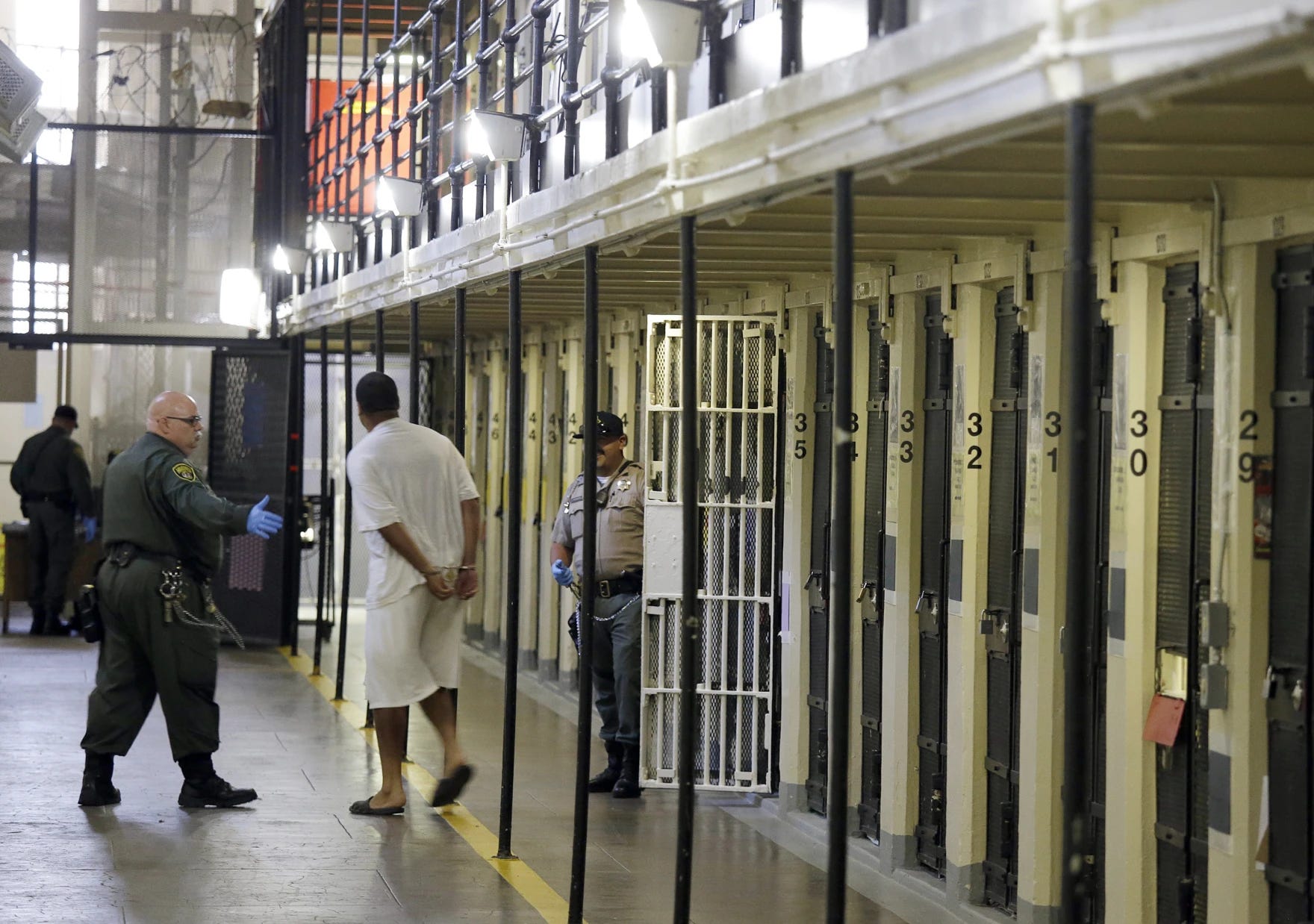
Earlier this month, California Governor Gavin Newsom commuted the death sentences of all 548 inmates on death row in California prisons. In their Left & the Law segment, Jan Haaken and Mike Snedeker talk about the significance of this commutation in the context of national politics around capital punishment. They take up the history of the death penalty in the US as a bipartisan issue and how the midterm elections signal important shifts in public responses to law-and-order politics. Mike is an appellate lawyer who defends inmates on death row in California prisons. He explains why very little will change for them materially with this commutation.
Jan:
On November 5th, California Governor Gavin Newsom announced the largest mass commutation in modern U.S. history, moving to clear the state’s death row by commuting the death sentences of all 548 inmates to life in prison without the possibility of parole. His decision is part of a national pattern of states abolishing, putting on hold executions, or governors declaring a moratorium on the death penalty. Well, Mike, you work as an appellate lawyer with people on death row in California.
What’s your take on the importance of Newsom’s decision?
Mike:
Well, it’s a momentous decision in that it removes about a quarter of the entire death row population in the United States. But in some ways, I think it’s a very canny political move, and it has shockingly little effect on the ground because the death penalty has been dying slowly, but very steadily in California. There’s been no execution for the last 20 years, and there has been a moratorium in place since 2019.
Jan:
That Newsom put in place in 2019.
Mike:
Yeah. He has also demolished death row. Death row in San Quentin three years ago was destroyed by Newsom in that the gas chamber is gone.
All the people were transferred to various other prisons all over California. So there’s no place now where you could say this is where death row prisoners are.
Jan:
What does that redistribution within the prison system mean, in practical terms, for the lives of people who are on death row?
Mike:
Well, Lisa Short, who’s my wife and law partner, and I represent six people on California’s death row. And for one of them, it’s a really welcome, soothing act. For the other five, and generally speaking, it’s nothing particular, nothing special.
Two or three of them are preoccupied with guilt phase issues in their appeals. And nobody’s really sweating being executed because it’s been decades since anybody ever was executed in California.
So a death penalty there has died not with a bang. It’s not a transformative thing Newsom’s doing. But it’s been more like a whimper over the years, step by step by step. People have grown distant from actual executions and the living conditions, the re-designating who they are and where they should go. All of that has steadily moved them away from fears that they might actually be executed.
Jan:
You know, I think it’d be interesting to take up the different states of the death penalty and its politics and states around the country. But you were saying California has somewhere around half of the death row inmates in the country and hasn’t executed anyone in many years.
Mike:
That’s correct. They peaked out over 700. But there have been various legal decisions, deaths that have lowered the total affected by Newsom’s order to 548.
But that’s more than a quarter, almost a third of all the people in death row in the whole country.
Jan:
So what is Newsom responding to? And what is the political calculus for him, given that everyone expects him to run nationally for president? There is an ambivalence in California about the death penalty, rooted in the state’s political history. You know, ballot measures to abolish the death penalty have failed, including one maybe 10 years ago. I don’t know if that would fail again.
But why is there this, I guess you could call it ambivalence in the state of California? They put a lot of resources into the rights of people to have appeals, the process of appeals, certainly far more than in the South. But yet a lot of people are convicted under capital crimes.
Mike:
Well, it’s always a political question. And California is a split state in many ways. The Central Valley of California, San Joaquin Valley, very conservative, agriculturally oriented.
These kinds of areas have always been opposed to cities throughout the world. The split between cities and countries here in Oregon is notorious. Blue Portland versus red eastern Oregon is inherent in some ways in the economy.
The countryside produces food and wants as much money as it can get for the fruits of its labor. And city people want to pay as little as possible. Bosses want to minimize the workers’ money, and therefore they will take acts like in Mexico to make cheaper the food that their workers require.
So there’s a split between city and country. Country DAs, they’re fairly prosperous in the Central Valley.
Jan:
They have political clout there.
Mike:
They got muscle. And they define themselves in opposition to the metropolis, the coastal elites of Los Angeles and San Francisco. And in L.A., too. L.A. has, you know, let’s not forget California was generally Republican not all that long ago.
Jan:
It was Reagan and Nixon.
Mike:
And George Deukmejian and Schwarzenegger. And the Republicans in Los Angeles convicted and sentenced to death all kinds of people. So, yeah, things have changed in California.
There’s no doubt about it. I think the big pivotal moment was an overreach by the Republicans appealing to white people to vote against Mexicans, to raise the fears of white people by talking about these “polluting worms” oozing up from the South. And Pete Wilson and his horrible ads about a measure - he was the Republican governor of California in the 90s.
So the Latino vote decisively turned against the Republicans. It has not gone back. It’s really echoed by what’s happened in this very election, when there were Latinos who are in many ways conservative, lots of people who have lawfully become citizens, resented newcomers charging across the border, threatening their privileges.
They’re Catholics. There’s a lot of libertarian types who consider themselves tough. There’s a whole many elements in Mexican culture that are fairly conservative.
But it became very clear over the last couple of years that their attitudes and feelings are totally irrelevant to Stephen Miller and Trump, who believes that because they are brown, they can be arrested and should be arrested.
The Changing Face of Law-and-Order Politics
Jan:
Just the blatant racism around the law and order campaigns of Republicans, which has connected public anxieties about crime to brown people particularly, as well as black people, but particularly brown people. And we’ve seen this on full display and rejected by much of the country in sizable majorities. But is the right-wing rhetoric on law and order and crime, the threat of crime, which appeals to something very primal in people, is that a different kind of rhetoric than in earlier eras?
Mike:
Well, it’s certainly a less effective rhetoric. I mean, being tough on crime was de rigueur for any politician in the 70s, 80s, and 90s.
Jan:
Even Democrats?
Mike:
Everybody. Absolutely. Anybody who wanted to run for public office, including Democrats, Republicans, all had to be tough on crime, had to pretend to be deeply concerned.
Voters could tell whether or not you really felt it. Bill Clinton went way out of his way to fly back to Arkansas in 1992 to watch the execution of a mentally disabled man who had no idea that he wouldn’t be having breakfast tomorrow morning, Ricky Ray Rector. Clinton presided over the passage of a habeas corpus law that has done more damage in the area that I work in of criminal justice, serious crimes, and constitutional rights.
The 1995 habeas corpus law has been a disaster for anybody trying to file a petition for a writ of habeas corpus.
Jan:
Can you explain that a little more?
Mike:
Well, yeah, it created a standard of proof that is essentially taken away from federal courts, their right or their duty to review state actions to see whether or not they’re constitutional. He’s eviscerated the federal courts. And right now, there is a big case pending before this U.S. Supreme Court that would challenge this statute as having been overreaching, having eliminated powers of the judiciary that have been in place since the early 19th century. And the court did a similar thing about administrative law. They said you cannot deprive the judiciary of the right to rule on administrative agencies. The Chevron decision.
Well, now people are saying that also applies to criminal law. Congress and Clinton essentially passed a law that deprives federal courts of their rights and duties to review state decisions for their constitutionality.
Jan:
There are laws that prohibit states from executing people with intellectual disabilities. And yet there have been tragic cases—not only the one you cited involving Clinton, but also Florida’s recent execution of a man who was clearly intellectually disabled. How is a state like Florida, which carried out 57 percent of the executions this year, able to do that, given the federal laws that would seem to prohibit these blatant forms of injustice?
Mike:
Well, the law I’ve been speaking about eliminates a lot of lower court ability to correct any unconstitutional decisions by state courts. But the U.S. Supreme Court has never inhibited anybody from killing in the last few years. There is effectively no federal oversight now of states so that when a state governor like DeSantis wants to make his mark as a killer, there’s no federal impediments to him doing that.
So he’s carrying the mantle from Texas, where everything has become more clogged, more ambivalent.
Jan:
Can you talk about the support, particularly in the South, for the death penalty, where most of the executions have been carried out, where there are fewer protections or supports, for example, for the appeals for people on death row, and governors have a freer hand with this? And is now the rise of progressive politics and Black activism in the South a challenge to that? I mean, the death penalty hasn’t been talked about in the midterm elections, but I think it is part of this right-wing package of cruel and racist policies.
Mike:
Well, I think this is the genius of Newsom’s actions, is that he recognizes that crime as an issue has receded drastically. It’s finally recognized that the rate of crime has fallen dramatically over the past 30 years. You know, crime is essentially a young man’s game, mostly committed by young males between 14 and 40.
And during the baby-boomer bulge of population, there was indeed a great increase in crime. But crime peaked out in the early 90s, has been steadily falling ever since. Now it’s less than half of what was at its peak.
Jan:
And all the categories, violent crimes and property crimes.
Mike:
Yes. And there have been, of course, sociological studies showing that people’s awareness of crime tends to reflect election cycles more than reality. But overall, there is a general acceptance, a very profound level of recognition that crime is just not what it used to be.
And when people consider the issues that matter, they think about the cost of living. They think about immigration. They think about every other issue other than crime on any list now.
Crime trails dramatically. So Newsom knows that. He knows that there are fervent supporters of the death penalty, as always. But in the great cycle of things in this United States, it’s a downturn. People aren’t really worried about it. It’s not a preoccupation. It’s certainly nothing that any politician is going to go out of his way on day one of his campaign to go highlight.
Jan:
I’d like to offer maybe a different take on that, the shift in the political discourse on crime. I think certainly through the Clinton era, the late 20th century, Democrats use euphemism and even the Republicans use kind of these dog whistles. And they’re not just overtly racist and cruel in the way we are seeing now Republicans all over the country.
And I think people have learned, even people who are not paying a lot of attention to what’s going politically, have just seen the extreme racism and ugliness and cruelty and bizarreness of claims, like Haitians are eating your pets, or all these people are going to come over the border and rape your wives and daughters. And it lacks the kind of skillful political posturing of earlier eras, where there was also this ugly racism, but it was packaged in a way that landed differently. So I think part of what’s been happening in recent years is people seeing what’s really behind this so-called law and order politics.
Mike:
Well, I think part of the problem is that there were indeed a real increase in crime in the 70s. So the Republicans could look at you and sincerely say what they were thinking about crime. They could be racist in an emphatic and unambiguous way.
But now they’ve got to reach. They’ve come up with these claims about Haitians and dogs. It’s not like it was before.
Jan:
Right. New York City is such a prime example. There are so many films set in the 80s where New York City looks like Gomorrah.
I mean, it’s like a city where murders happen every, I don’t know how many minutes, and everything is ravaged by the criminals. And now you look at New York City and the smiling Mamdani with his sewer socialism, fixing potholes. And it’s like, if you set side by side images of New York City in the 80s and now, it’s a dramatic contrast, for sure.
Mike:
It is indeed. Newsom has caught up with that. Crime was the issue from Willie Horton on in the 1988 election. Crime was the central issue for the presidency of the U.S.
Jan:
Can you remind people what the Willie Horton campaign was about?
Mike:
Willie Horton was a black man convicted of rape who was let out by Dukakis early and killed a woman.
Jan:
Dukakis was governor of Massachusetts.
Mike:
Right. And George Bush discovered this fact that had happened during Dukakis’s time as governor and would not shut up about it, emphasized it. And Dukakis acted in a very defensive way, and it became really a definitive issue in the whole presidential campaign. Crime became the issue of the 80s.
In the California election, to recall justices of the California Supreme Court, it was death, death, death. The rhetoric, even though the money came from agricultural and insurance company interests, the rhetoric was all centered about the death penalty. And what we’ve seen really is the death of crime as an issue.
And it’s faded way away from all the concerns of corruption and immigration that now dominate our discourse. And Newsom knows that. He’s a canny operator.
He is an operator. There’s no doubt about it. He’s tight with tech bros and money in California, but he’s also smart.
And he earned himself a big reputation by allowing same-sex marriages in San Francisco in 2004. It was a scene of great joy in San Francisco for two or three months until it got squelched.
Jan:
Like in Oregon, that summer of love, right? Before it finally passed again. But you’re saying he’s kind of taking this up in a way, whatever we think of Newsom as a politician.
I think he’s bringing the death penalty into the platform of the Democratic Party in a way we haven’t seen.
Mike:
Crime has faded as an issue. It hasn’t been talked about. But the fact that it really is not a determinative issue anymore is really going to be brought home by what Newsom has done, because I don’t think it’s going to hurt him.
If anything, it will buttress him as a person not afraid to take principled positions, thereby distinguishing himself from Kamala Harris and a lot of other Democrats. And he’s got some serious competition now. This recent election has shown that there’s quality people in the Democratic Party, governors of Texas, of Georgia, senators.
You know, Mamdani, I think, has shown the way of being forceful and not being worried or nervous about whether or not your liberalism is going to be misperceived. That whole take by Democrats that we’ve become so accustomed to has been blasted out of the water by this new crop. And so Newsom needs to do something to keep up.
And I think this is, for him, a consummately political move. But it’s going to have a profound effect, because the death penalty is fundamentally, as he says, it’s wrong, it’s misguided. We never know enough to determine, first, exactly who committed the crime, and secondly, what circumstances that person endured as they grew up.
These are all mysterious things that are beyond the idea of the state commanding its powers to execute and kill people itself. It’s one that should be really obsolete. And I’m happy to say that it is becoming that way.
And now Newsom formally really deals it a hard blow.
Beyond the Death Penalty: Is Life Without Parole Really Justice?
Jan:
You know, I wonder, though, how courageous this really is. I mean, it signals something. But, you know, 18 states and the District of Columbia have abolished the death penalty.
More, including Oregon, have declared moratoriums. Is life without the possibility of parole a really progressive place to land with this?
Mike:
Not at all.
Jan:
I’m always a little uncomfortable with all of the celebration of these moratoria, given what still we have one of the most brutal criminal justice systems and incarceration rates in the world.
Mike:
Well, we can’t really address the question of life without the possibility of parole, so long as there’s a death penalty. The death penalty sucks all the air out of the room. If it’s gone, then we can, and we should, take a careful look.
Jan:
Has that been the case in states that have abolished the death penalty? Has it been part of a larger pattern of prison reform?
Mike:
Well, there has not been that big a change. These 18 states without the death penalty have not had it for decades. And so, yeah, it’s not as though there’s been a wave of legislation.
Jan:
You know, Democratic Socialists of America has promoted an abolitionist politics, which has made them targeted by candidates associated with DSA. But I think the question of what kind of progressive politics we want to put forward in the aftermath of the Black Lives Matter movement, and the evisceration of the Civil Rights Act, and many of the protections of Black and Brown people in the courts, I think that would be something to revisit on the left. What would be an important platform around criminal justice reform?
And I know we can’t take that up today, but I think that’s really important. And to some extent, these progressive politicians kind of sidestepped that issue, even DSA members, because abolishing the police and prisons is aspirational, but people saw it as, you know, not a serious program of political reform.
Mike:
Well, the death penalty is profoundly racist. Governor Newsom made that very clear. That’s one of his chief reasons for abolishing it.
The race of the victim is remarkably determinative in who actually gets sentenced to death. But once the death penalty is out of the way, we can look at the racism that remains in life-without-parole (LWOP) sentencing. The death penalty is thriving only in the backwaters of the Republican Party in a South that has shrunk for the Republicans dramatically.
Georgia and Texas are no longer part of this show. They are in at least purple states, if not blue states. It would not surprise me at all if the tremendous number of Latinos in Texas do not revert the next election cycle, and that Texas becomes more like California, and that the issue of crime and punishment is very affected by race, and we can see just how that manifests more clearly if the death penalty is not blocking our view.
Jan:
So, in concluding, Mike, what’s your post-midterm election takeaway on the fate of the death penalty and also the politics of law and order? And what kind of hope do we have in these hard times?
Mike:
Well, I’m delighted to see Governor Newsom stand up and do what he did. It’s a decisive, clear, rational act that will have profound effects. Having said that, I’m in some ways even more heartened by the fact that he, as a political operative, finds it to be in his interest, because he needs to be a person of principle and to be perceived as one in order to get anywhere in his presidential campaign.
Jan:
Including around his association with being smarmy and tied to the wealthy.
Mike:
Exactly. This is a way by which he can combat that, and I’m exhilarated by the fact that crime is not such an overwhelming issue that compels the worship of harshness by all politicians. The fact that crime has been steadily dwindling for 30 years now is finally taking hold in the public consciousness, and we’re moving on to other issues, more profound issues, which we can talk about some other time.
Jan:
Okay, thanks, Mike. And keep up the good work in California, and we look forward to hearing more about the fate of many of the people you work with there on death row. Thanks so much.
💬 Share Your Thoughts
Can a state truly move beyond the death penalty if it simply replaces execution with life without parole? What should the next stage of criminal justice reform look like?
Find alternatives to prison sentences. Prosecutors can suggest them. Empty the prisons. Humans do not belong in cages.