

Even the most delusional and demented person can have moments of lucidity. So too with President Trump (AKA the Mad King). When asked about his frenetic self-memorializing across the capital, Trump explained recently that “nobody will do it once I’m gone.” No site of historical or cultural significance escapes the President’s searching gaze. In response to those who accuse him of imperial self-aggrandizement, Trump states without a hint of defensiveness or shame: “That’s true. Nobody will do it once I’m gone. When I leave here, nobody will.” He knows that the sycophants surrounding him harbor contempt and hatred for him. He is feared but not loved. Only Natalie truly loves him.
Rituals around death and dying are among the hallmarks of our species. Other animals express grief and loss in ways that suggest forms of sentience of death that are not exclusive to humans. But humans have produced cultural practices around grief and mourning that are integral to our long-term survival. Such practices involve symbolic systems for placing individual life within larger cycles of death and renewal.
After the Second World War, psychologist and Holocaust survivor Victor Frankl published Man’s Search for Meaning, a book that describes life in concentration camps and how people survived amidst such horrific death and suffering. Most of his family died in the camps and Frankl himself spent three years in four concentration camps. He observed that caring for other people and for the small tasks of daily life–for finding ways of holding onto one’s humanity amidst such inhumaity–were vital to survival. The Palestinians in Gaza, through their capacity to hold onto their humanity amidst a genocide, have inspired a global justice for Palestine movement.
Many Indigenous traditions are based on similar existential principles. Cultural practices center on developing forms of selfhood grounded in care for the natural world and in an identification with future generations. The existential principle of seeing oneself as part of a larger cycle of life, or part of a historical struggle for justice, invokes notions of the transcendent, of something larger in which one finds comfort and a sense of connection..
Kings and emperors, on the other hand, plan monuments attesting to their power beyond the grave. But these projects are typically carried out by lineages or political formations in their wake. Trump trusts only himself to the very end to see that he is properly memorialized.
Is the Mad King Dying?
There are many signs that Trump knows he is dying. There is his increasing detachment from worldly affairs. There is the monument building but also the way he openly talks about his death (“when I’m gone…when I leave here.”)
In many ways, Trump is more grounded in reality than his tech billionaire allies. In the feverish world of AI, death can be avoided (along with taxes). A February 2026 Forbes article describes this philosophy: “The Death Of Death: How Immortality Became A Technical Problem For Founders.” While warning that their technology could wipe out most of our jobs as well as all of humanity AI promoters wax rhapsodic on how their labs are unlocking the secrets to eternal life. Musk the techno-philosopher explained this to Fortune magazine earlier this year: “You’re pre-programmed to die. And so if you change the program, you will live longer.”
Commentators note that Trump, famous for declaring worries about AI being a “hoax,” is not onboard with this techno-futurism. He is a real estate guy who surveys the lands within his reach to make deals. Yet many of those deals seem to be of fading interest as Trump retreats into his gilded castle.
In a May issue of The New Republic, Greg Sargent reports that “He’s not talking about building a wall. He’s not talking about the war in Iran, trans figures and athletes in sports. He’s so far beyond that. The ship has sailed—even whatever he ran on last time. He’s talking about himself and his own majesty.”
He goes on to observe that “The cult-like defenses of Donald Trump have taken a truly creepy turn of late…when you watch all this madness, you can sense something dark underneath it. All these sycophants are plainly aware that Trump is going to be passing from the scene very soon. And it’s very hard to see what’s going to fill the vacuum within the GOP and the right wing that this will leave behind.”
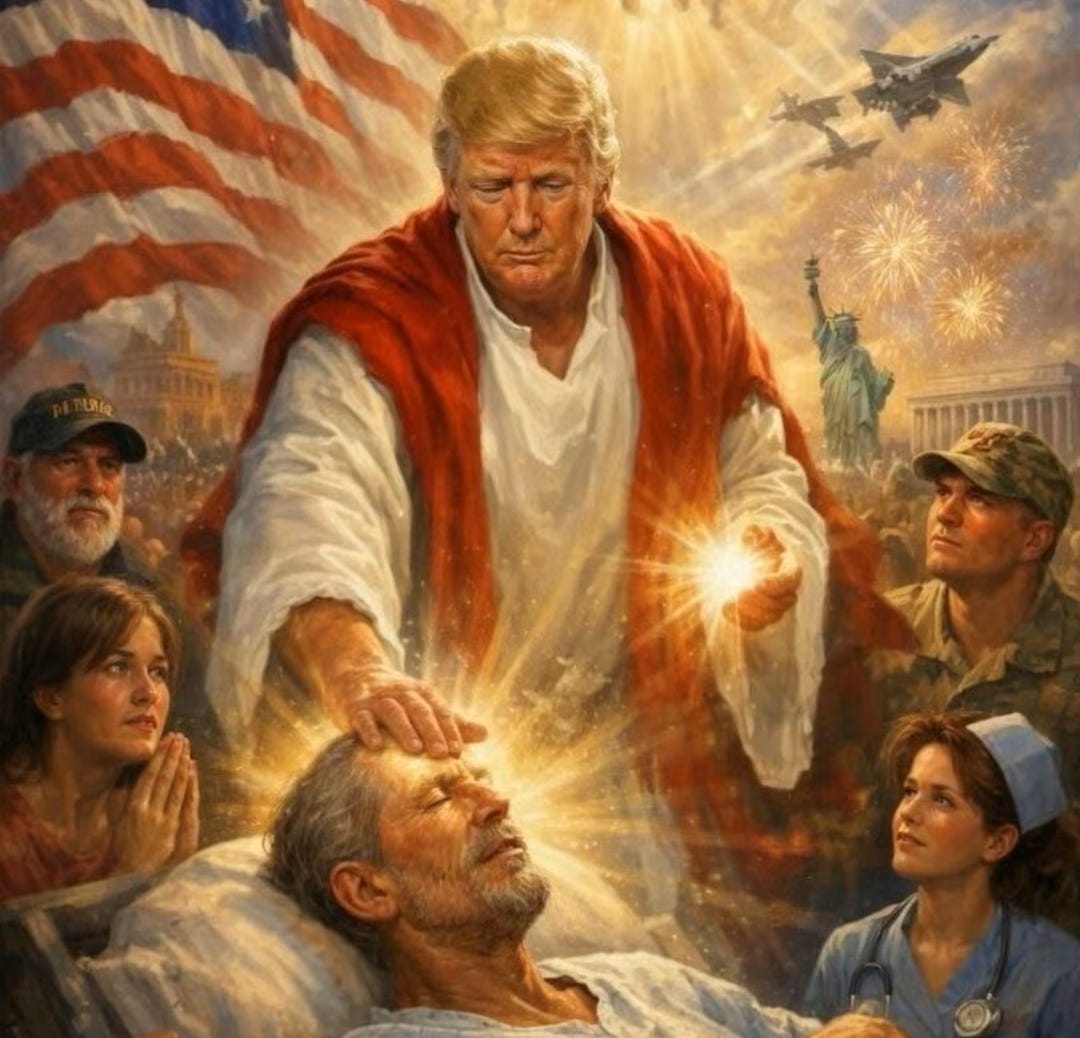
Trump is not leaving it to the MAGA faithful to fill the vacuum. He is probably the least religious president in US history. His AI generated image of himself as Jesus Christ was a testament to his true faith.
Although he mused some months back about whether he would get into Heaven, Trump muses all the time about things he probably doesn’t really believe. Like that he won the 2020 election. Or that his inauguration crowds were bigger than Obama’s. He knows that his destiny lies with his imperial claims on the Nation’s real estate.
Trump has created hell on earth for vast numbers of people but whatever heaven he can imagine has to be built here on Earth by him and for him alone.
Many MAGA evangelicals who support Trump imagine a heaven with streets of gold, turning to their favorite book of the Bible, the Book of Revelations. It describes the great street of the heavenly city, the New Jerusalem, as being made of “pure gold, like transparent glass.”
One would expect that his Christian supporters would see the blasphemy in Trump’s god complex and self-idolatry. (First Commandment: “Thou shalt have no other gods before me”.) The only limit on his power, Trump told the New York Times earlier this year, was “my own morality, my own mind — it’s the only thing that can stop me.” A recent Truth Social post boasts that “The only control or ‘guardrails’ that Al needs is a STRONG AND SMART (High IQ!) PRESIDENT, and the U.S.A. has that, in spades!”
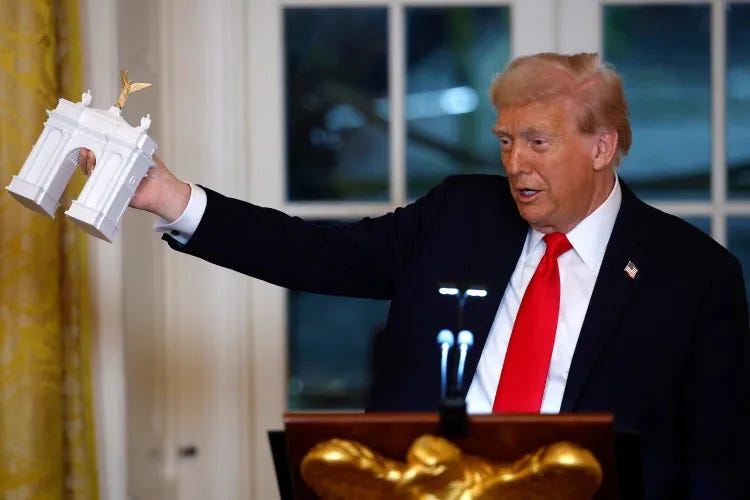
The pundits incessantly reporting on Trump’s maniacal behavior seem to have missed the signs with this monumentalizing. One symptom worth taking seriously is Trump’s mad dash to build the 250 foot Trump Triumphal Arch in DC. “It’s for me,” he says. But a few days later, a military and security rationale was rolled out much like the rationale for the ballroom.
Trump explains that the Arch will “house, store, and have the rapid ability to use large numbers of drones, plus Snipers, on both the roof and plaza areas, and additionally have and hold large quantities of sniper ammunition in storage.” Military commentators list many reasons for why this is a crazy idea. This garish structure would obstruct the visual path between the Arlington National Cemetery and the Lincoln Memorial. This aspect of the project is most concerning to veterans who are filing lawsuits to stop construction.
Much like tearing down the East Wing to build his ballroom, Trump uses the military and security apparatus to justify these projects. But there is a psychologically primitive aspect to this fortification of real and imagined monuments. It is an externalized projection of his own empty psyche.
Napeloenic Fantasies
Many leaders throughout history have built monuments to their power, many erected to overshadow their predecessors — a practice known as damnatio memoriae, or condemnation to oblivion. Trump the builder specializes in such practices, driven by a deep and devouring psychic state of envy. His fixation on plastering his name on the Kennedy Center in Washington DC is a case in point. Like many leaders stricken down in their youth, JFK was enshrined in American political memory. Most baby boomers and their parents remember where they were on the day that Kennedy was shot. No such memories will be imprinted on the day that Trump gives up the ghost.
An even more telling manifestation of Trump’s megalomania was early in his second term. Trump posted one of those Truth Social decrees that soon became his signature mode of governing. With an AI generated image of himself as Napoleon Bonaparte, Trump added a quote from the French emperor: “he who saves his country does not violate any laws.”
Trump is not an educated person. Television is his main source of information and his main window onto the world. But he has read something about Napoleon Bonaparte that inspires him, although he likely avoids the conclusion of his story.
Napoleon died in exile on the island of St Helena in 1821 and was buried there. In 1840 the French brought his body back to Paris to be buried at Les Invalides, the palace built by Louis XIV to house military veterans and to honour France’s military heroes. Trump prefers the story of the early 19th century Napoleon Bonaparte who built monuments in Paris— the Arc de Triomphe and the Vendôme Column, both modeled on Roman architecture. The Arc de Triomphe was commissioned by Napoleon in 1806 to celebrate the French victory at the Battle of Austerlitz. Completed in 1836, the Arc houses the Tomb of the Unknown Soldier, which honors soldiers who died without proper burials. Even with his purported little-man complex, Napoleon honored fallen soldiers. For Trump, dying in battle is for losers.
Revolution in the Air
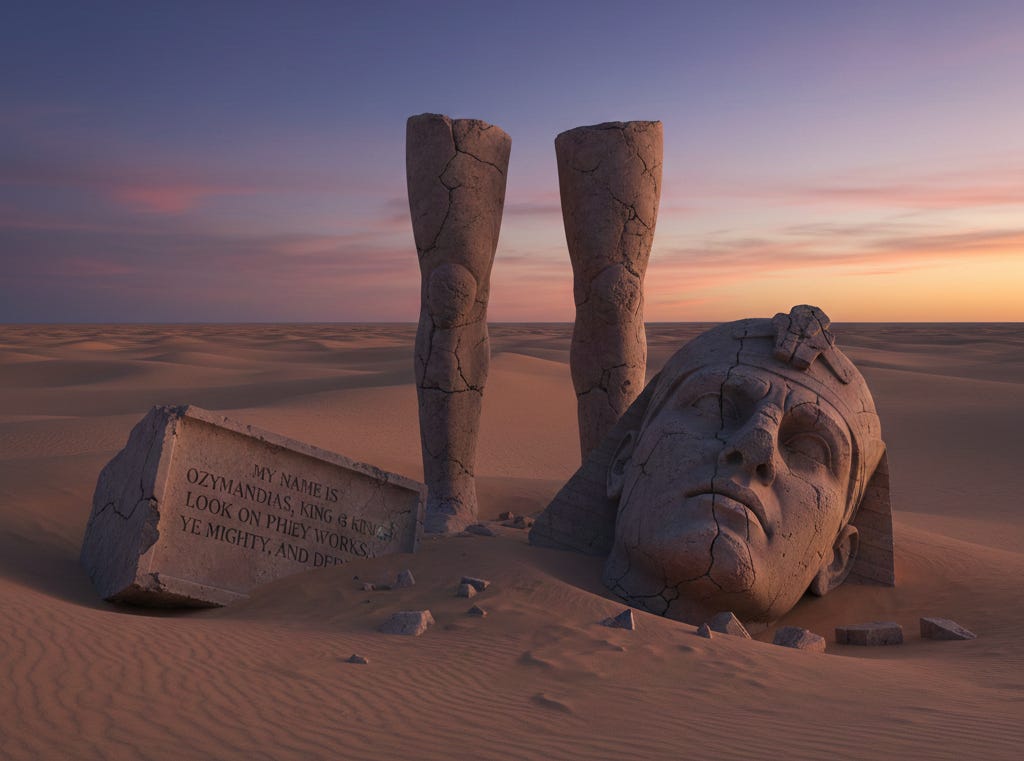
In an 1818 poem titled Ozymandias, British poet Percy Bysshe Shelley wrote the ultimate obituary for monument-making tyrants. It describes a statue, erected by an ancient powerful and totally forgotten ruler, that is now crumbled on the sands of a desert. It bears the inscription “My name is Ozymandias, king of kings: Look on my works, ye Mighty, and despair!”
When Trump dies, politically or physically or both, there will be jubilations in the streets and hammers and wrecking balls to take down many of these obscene monuments. The current crises of this country under the Trump regime are symptomatic of deeper dynamics of American capitalism and concentration of corporate power, however. Building a better world involves organizing around a vision of our shared humanity and interdependence. Our survival depends on our ability to repair the destruction inflicted on our ailing planet–destruction that will be, in no small part, Trump’s true legacy.
The November elections hold promise for bringing the regime to its knees. But Democrats capturing the House and the Senate will certainly not be enough. Many of these politicians are quite comfortable with the system. Young people particularly are looking for radical change, for another way of storming the Capital.
💬 Share Your Thoughts
Why do powerful leaders seem so drawn to monuments and symbols of their own legacy? Is it about history, power, or something more personal? Can a society really build a better future without confronting the ways power and wealth shape whose stories—and whose monuments—survive?