

Originally published in CounterPunch on September 18, 2026. Read Part I and Part II.
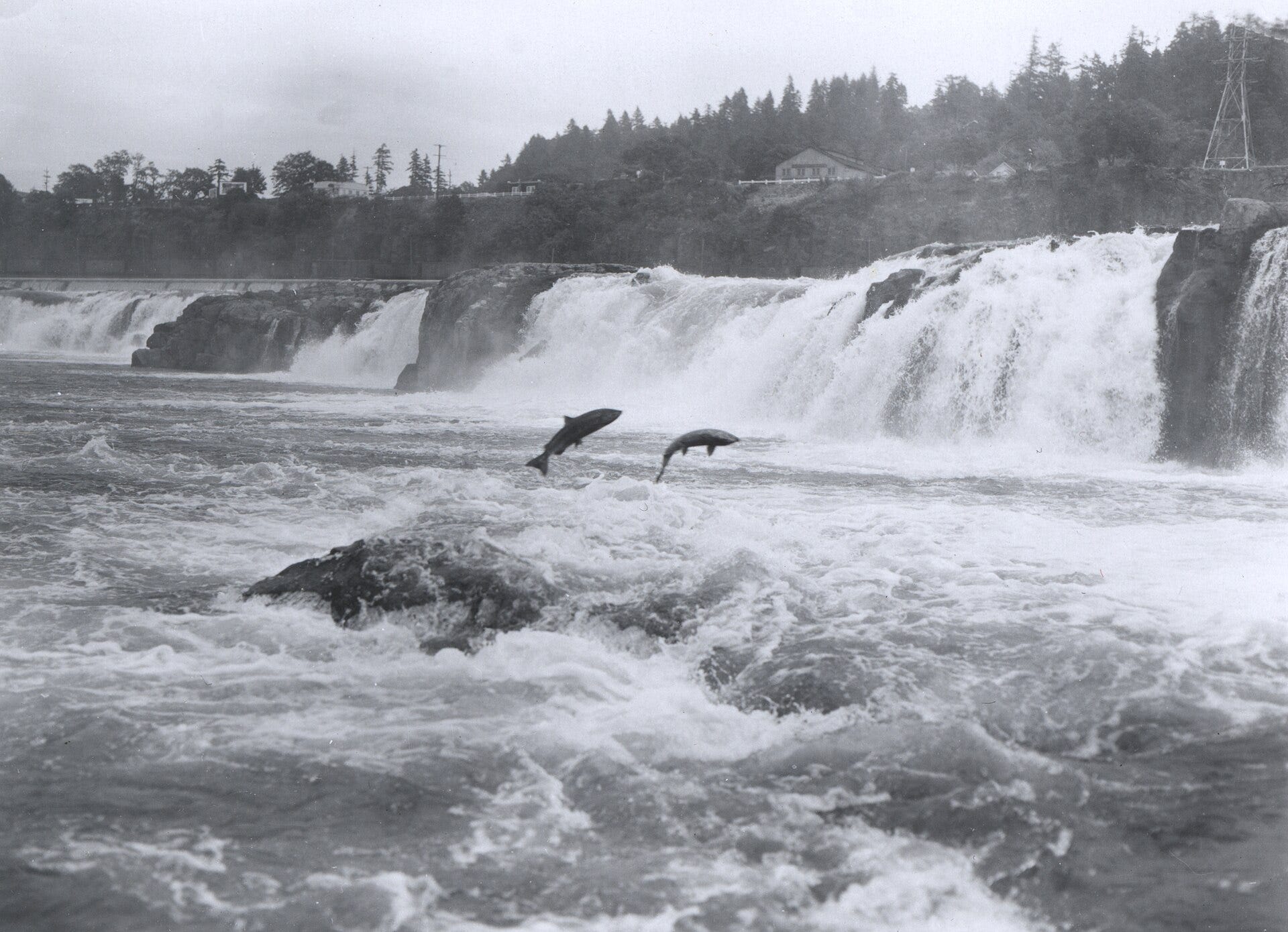
As a Wallulupum friend once instructed me, “you have to learn to think like a salmon.” I have been trying to think like a salmon, which began with imagining a desperate struggle against swift currents amidst predators that threaten to kill you and your progeny. Salmon face a harsh torrent of dangers in rivers in this region. The Dalles dam that flooded Celilo Falls along the Columbia River in the 1950s destroyed a vibrant Native trading site. These dams are also lethal to fish. My friend tells a story to bring the lesson home: “My Uncle Billy Frank once said, ‘everytime you turn on a lightbulb, a salmon jumps out because it gave up its life for you.’” Her Uncle Billy is legendary in the Pacific Northwest for his role in the “Fish Wars” where tribes enlisted treaty rights to protect vital fish habitats.
The complex life cycles of salmon find parallels in the intergenerational resilience of tribal peoples. Just as the Pacific salmon have been threatened with near-extinction in some rivers for over a century, Native Americans have seen devastating reductions in their numbers and territory. And yet both the salmon and tribal people survive. They are still here.
Of the seasonal foods that sustain Northwest Indians, salmon occupy a place of profound spiritual significance. Tribes carry moral obligations to protect these animals that have sustained them for millennia along the Columbia River and its tributaries. In Northwest Indian creation stories, the Creator brings salmon as the First Food. Some legends describe the original people as living under the ocean with powers to transform into salmon. They offer themselves as food to land people–a legend that inscribes the sacred place of salmon in the lifeblood of the tribes.
Indigenous Psychologies and Storytelling
My charge of thinking like a salmon started with tracing my heritage as a granddaughter of immigrant Norwegian fishermen and of untangling some of the threads of settler/Indigenous intersecting histories. In the course of working with Indigenous communities on the climate crisis, I have come to see my own survival as hanging on these same threads.
Imagining salmon engaged in a valiant struggle, as my friend’s Uncle Billy invites us to picture, opened for me new ways of thinking about the non-human animal world as well. In Euro-American cultures, animals enter storytelling primarily through childhood tales and fables. To grow up is to leave the world of animal adventures behind. From this way of thinking, Indigenous elders and their cosmos of earth spirits represent a child-like worldview. Indigenous psychologies, on the other hand, stress the embeddedness of human ontology in the sensory environment and cohabitation with other life forms. From this perspective, the absence of the natural world as a constitutive part of child development is striking. Educators now speak of “nature hunger” as one of the deprivations of childhood, a recognition of the impoverishment of the prevailing Western models. Indeed, Salmon people ground their rituals in the sensate world. Spirits coursing through waterways and land masses accompany humans in seasonal passages.
The Return of the Sockeye
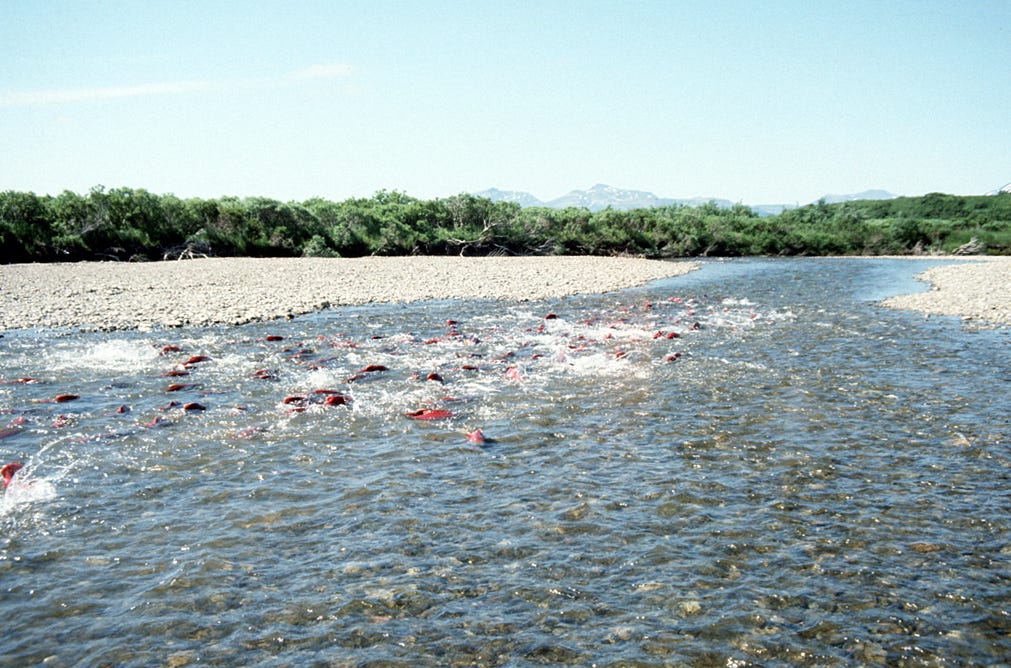
In October of 2022 I was able to join the Skwlax Little Shuswap Lake Band in eastern British Columbia as they welcomed the return of the sockeye to the Adams River. They gathered to celebrate what the Band describes as “the cycle of life and the journey back to the Adams River, their place of birth, in the Secwepemc.” It is a story of determination that registers a deeply held spiritual principle. After four years and a journey to and from the Pacific Ocean and “against formidable odds, obstacles and dangers,” the sockeye returns. So too do the tribal people who gather to welcome them. Salmon are indeed awe-inspiring.
Pacific salmon possess some of the most complex life cycles in nature. Five species of salmon live in the North Pacific waters of the US and Canada: chinook (also called king), coho, pink, sockeye, and chum salmon, and each face pressures around survival. Chinook is the trade language developed to communicate among tribes and to non-Native traders in Oregon and Washington, named for this most prized of the Pacific salmon species. All of these species develop physical structures in the course of maturation that allow them to move from the freshwater habitats of rivers to the salt waters of oceans. This itself is one of the marvels of nature. Salmon migrate over a thousand miles before returning to their spawning grounds. After one to seven years in the ocean, adult salmon that have survived countless hazards from predators, ocean conditions, and commercial harvest return to their river and spawning grounds. Arriving at their home stream, females build a nest, or redd, in fine, clean gravel. Salmon live off their own body fat as they return upstream to spawn. For the sockeye, their vivid red and orange color signals the last phase of a cycle that includes consuming their own flesh to sustain them in the many months of their migration. As a female deposits her thousands of eggs, a male releases milt, fertilizing them before they perish in that last reproductive act.
Gazing out over the sockeye activity on the Adams River, I felt sad as I watched the gray dead fish floating in the estuary amidst the others after completing their spawning. Salmon have a great deal to teach about death as well as life.
Norwegian Settlers
I come from a long line of Norwegian fishermen and farmers, immigrants who could remember what they wore when they got off the boat in America. There were stories of wrenchingly tearful separations from parents in Norway and recollections of the precious belongings taken for the voyage. Cod and pickled herring were the staple food of my ancestors, as were methods for preserving fish. Lutefisk–cod soaked in lye, steamed and served with melted bacon fat or butter—was the beloved communal dish of my parent’s generation. These peasant foods from the old country signified for my parents, like so many first-generation immigrants, their ties to the hardships of the world left behind by their elders.
Fish was important in celebratory gatherings and was prized as a gift. But my parents would not welcome the idea of “thinking like a salmon.” They explicitly condemned paganism, their term for a loose set of heretical beliefs that encompassed various Old Norse gods and images of animal spirits in folk beliefs prior to Christianity. The vestiges of Nordic paganism were discarded, even as kitchen cabinets continued to display an assortment of painted wooden trolls. But the cultural significance of fish and fishing was undergoing transformation as immigrants entered the machine age of industrial capitalism. Fishermen in my family arrived in America during an era of intensive commodification of salmon with the rise of the canneries in Alaska and along the Pacific Coast.
My paternal grandfather left Norway three days after marrying my grandmother, his cousin—who was six years his senior and an accomplished seamstress. In 1897, he departed from Stavanger as part of the emigration of thousands of Norwegians underway, seeking a better life in America. Growing up in a village on a coastal island off of Stavanger, with herring and cod part of the subsistence economy, my grandfather John found work on a salmon tender in Alaska. He had arrived in Montreal by boat and then traveled by train to the West and found his way to the Aleutian chain in Alaska where canneries were hiring Norwegian fishermen. Working his way up to the position of foreman, he seized an opportunity to trade with the canneries as a fish broker. Grandpa John returned every three years to Norway, following the path of his migration much like the migratory salmon. My grandmother’s pregnancies marked these homecomings. Grandma Regla finally came to join my grandfather in America in 1910, pregnant with my father who was born shortly after Regla arrived on the West coast after a long trip by rail across Canada.
Capitalism and the Canneries
Grandpa John was among the Norwegian fishermen recruited by cannery owners during the first wave of exclusionary laws against Chinese workers in the late 19th century–workers who had provided the immigrant labor in the early development of the industry. Indeed, the first machines that were developed in the mechanizing of salmon canning were called “iron chinks,” a reference to the pejorative term for the Chinese. For cannery work such as soldering the tins, cleaning the fish, and packing the cans, Chinese laborers (and later Japanese and Filipino) were paid the least. Like the Chinese, Alaska Native workers were positioned at the bottom of the cannery’s social hierarchy. In the cannery system, the highest paid were the Scandinavian fishermen and other white crew on trawlers. Racial and ethnic differences served to “naturalize” divisions of labor and social hierarchies with their differential forms of exploitation.
During the years of my grandfather’s work in the Alaskan canneries, the US government had recently purchased Alaska from the Czar and took over the reins of Russian imperial control. The Bureau of Education established residential schools in rural Alaska for the Iñupiat children, typically under contract with European-American missionaries. Much like residential schools established through government policy across North America for over a century, these residential schools produced generations of trauma for Native people that continue to this day.
For many descendants on my father’s side of the family, working in a salmon cannery in Alaska became a rite of passage. My father and his brother arranged for getting jobs for nieces and nephews as well as enchanting us with Alaska fishing stories. Both of my brothers and one of my sisters found their way up north in their early 20s to make real adult wages. For white kids in that world, it was not hard to move from gutting salmon on the cannery assembly line to snagging a position as crew on a trawler or fishing boat. I still live in the house that my former husband and I were able to buy with a down payment from his salmon fishing take in Bristol Bay. He fished with my sister Joanie and brother-in-law George who shared a sentiment common among old fishermen, one that shares an affinity with the Salmon People:
“The natural world always has the last say, no matter how clever we think ourselves. Fishers know this in their bones.”
The Fish Wars
In Unlikely Alliances, geographer Zoltan Grossman chronicles decades of rural conflicts between Native leaders and non-Native farmers and ranchers over treaty rights and access to natural resources. Grossman traces the history of alliances forged in various regions of the US, beginning with the Pacific Northwest in the 1970s as fights erupted around oil pipelines, logging, dams, mining and nuclear projects, some of which included strategic alliances over local land resource issues.
Grossman takes a close look at the “Fish Wars” in Washington state during the 1960s and 1970s, a period of civil disobedience and other forms of activism carried out by Northwest tribes to pressure the federal government to affirm their fishing rights written into the 1855 Treaty of Medicine Creek. In 1973, thirteen western Washington tribes sued the State to restore their fishing rights. In 1974, federal district court judge George Boldt decided that the original treaties should be interpreted to mean the tribes were entitled to half of the harvestable fish catch. Inspired by the non-violent resistance of the civil rights movement, tribal activists organized “fish-ins”–actions where they exercised their fishing rights in defiance of state laws and the police. These actions and the Boldt Decision were met with violence by non-Native fishers “who cut nets, pushed boats into rivers, and stole fish from tribal nets and traps;” and “Native fishers often came under sniper fire or were threatened with firearms.”
Uncle Billy Frank
Much like other civil rights leaders who were despised by the power elite at the time and later venerated, my friend’s dear Uncle Billy Frank, who died in 2014, was later integrated into Washington State history in honorific fashion. He was posthumously awarded the Presidential Medal of Freedom by President Barack Obama in 2015. The Nisqually River Delta was also named after Billy Frank, whose visionary activism contributed to the preservation of the Delta–an area that had been confiscated by the US government in establishing Fort Lewis Army Base in the region earlier in the century. In 1999, a Seattle Times article looks back on the dramatic import of the Fish Wars: “As in any good tale, there were good guys and bad guys, and for most of the story, Billy Frank was considered a bad guy. He was arrested more than 40 times over three decades…His whole tribe was viewed as a band of outlaws, as were all Indians who dared defy the state.”
A paradoxical and surprising aspect of the Fish Wars was how tribal assertions of sovereignty and treaty rights brought communities together even amidst fierce white backlash. The tribes were able to show how treaty rights benefit non-Native people as well as tribal communities. Deep attachments to place and notions of stewardship in protection of natural resources were vital to this forging of alliances. Billy Frank is remembered for his skills in building these local strategic alliances. When the tribes sought to oppose a nuclear plant near Swinomish which posed a radioactive threat to salmon runs, Washington State Attorney General’s office warned that expansion of treaty rights could give power to the tribes to block major highway, real estate and energy projects. Quinault Chair Joe DlaCruz argued, “I saw the ‘fish wars’ as a catalyst to bring people together.”
In the late 1970s, the Confederated Tribes of the Umatilla and other Northwest tribes engaged in a similar life-or-death struggle with white fishers over the newly won legal rights of tribes for half of the fish harvest along the Columbia. Tribes began to reach out to white farmers and ranchers around dam breaches and other measures for protection of fish habitat. As tribes secured a series of legal victories in federal courts, they gained more clout around natural resource management. The tribes were not simply “stakeholders” or “interest groups” but rather were sovereign nations fighting for treaty rights built into the US Constitution. A series of cases the tribes pursued in the wake of the Boldt decision extended that ruling to include fish habitat and hatcheries–rights that went beyond apportioning the catch to include the habitat and conditions that affect the survival of salmon, shellfish and their ecology.
We Are All Salmon People
The Salmon People, including the generations that followed the Fish Wars, brought a paradigm shift in thinking about the ecology of natural resources and environmental threats that accelerated with the impacts of climate change. For the salmon, federal court rulings following the 1974 Boldt decision were important in moving beyond tribal protection of individual threatened species to a broader view of ecology that included habitats. While the Endangered Species Act (ESA) advanced some of these same protections, the ESA focus on specific animals on a list contributed to the political uncoupling of threatened species and their wider eco-systems.
In the “Woods Wars” of Oregon during the 1970s and 80s, bumper stickers on logger trucks were seen declaring “SPOTTED OWLS WON’T FEED MY FAMILY.” While that may be true, forests devastated by climate change won’t feed families either.
The climate crisis and the climate justice movement have stirred a profound “return of the repressed” in white settler consciousness. We are all Salmon People, as it turns out, living with other beings that require respect and care rather than domination and control. We have to learn to think like a salmon.
🎞️ Watch NECESSITY Part II: Climate Justice & The Thin Green Line

This film series unfolds around activists and their use of the necessity defense in jury trials in different regions of the US after being charged with trespassing.
💬 Share Your Thoughts
What responsibilities do we have toward species and ecosystems that sustain us? When does protecting one species become a question of protecting an entire ecosystem?