

You Can See Everything, the blockbuster documentary starring co-director Nathan Fielder and his subject Elizabeth Holmes, is chock-full of horrifying delights. Audiences are eating it up. The three hours running time “just flew by,” countless Redditt posts report. “You can’t look away!” others exclaim.
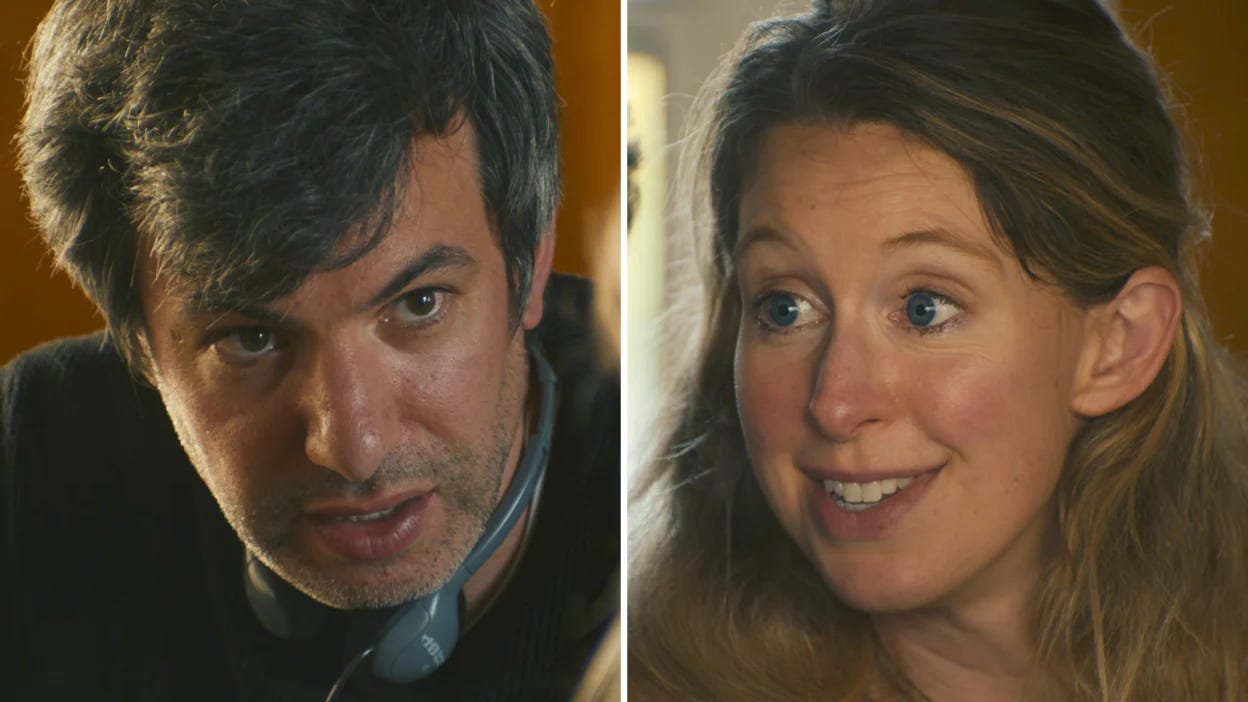
I too found this film absorbing and masterfully done. It’s skillfully produced from the opening scenes to the pen-ultimate and ultimate endings. The title is from a promise Holmes makes to filmmaker Fielder: “you can see everything.” For this comedian filmmaker known for his deadpan delivery of preposterous lines, this promise is a lure. But the more we look, the less we will see.
For me, this film was about the psychology of looking and how looking can blind a person to actually seeing. Like any documentary, there is a great deal of context that remains outside the frame. The extreme close-up shots of Fielder and Holmes gazing at one another in the trailer invites this context-stripped reading. Indeed, the first half of the film feels Hitchcockian in its voyeurism and exhibitionism. (For a film to watch as a companion to You Can See Everything, I highly recommend Alex Gibney’s The Inventor, as well as his behemoth doc Musk.)
Nathan Fielder repeatedly interrogates Elizabeth Holmes throughout the film on whether she knowingly deceived investors and others about her machine that would “revolutionize” health care by running hundreds of tests on a single drop of blood (taken from a finger prick). Depositions and evidence publicly available through her jury trial, along with years of impressive investigations by journalists and by former employees who became whistle blowers, produced massive evidence to support the criminal case against Holmes and the jury’s guilty verdict. She was sentenced to 11 years in prison and began her sentence in 2023 after several delays for giving birth to two children.
One of the most compelling aspects of the film centers on the Silicon Valley world of hustlers that created Holmes and made her blood testing machine (named the Edison) seem plausible. Her (Spoiler alert!!) sociopathic partner carries much of the bad blood in the film as he continues to court vampirish investors.
While he obsessively pursues the question of whether Holmes knew that her machine did not work, Fielder—like most obsessives—fails to see the bigger picture. Believing himself to be objective and highly rational, he comes under the influence of emotions he fails to recognize. We see him move from the periphery of the frame—standing in doorways and hallways of Holmes’s rented beach house—and then moving to intimate spaces in the interior of the house (plus a final scene that drives the point of his seduction home). The directors and editor were clearly constructing a narrative arc here.
Oppenheim and Fielder enlist approaches to documentary where the filmmaker and the process of filmmaking are central to the story. It’s sometimes called the reflexive approach where the story unfolds around the relationship between the filmmakers and their subject. Michael Moore draws on these conventions in his documentaries where we see him with his crew setting out to expose the ugliness behind the gentile facades of the powerful. Oppenheim and Fielder were undoubtedly guided by some of these same ideas. But they pushed them in ways that I haven’t seen, including in their creative use of re-enactments. For many of us as documentarians, the question is whether the audience understands that particular scenes are reenactments and whether they serve some larger truth pursued by the film. Oppenheim and Fielder actually explain their use of re-enactments. We see how and why they enlist this device. All good.
The Deal with the Devils
In 2023, Elizabeth Holmes and her partner Billy Evans approached A24 studio—a company known for artistically produced films—asking them to make a film about Holmes and her family during the month before she starts her prison sentence. She promises complete access and transparency, a common form of exchange between filmmakers and celebrities who in turn promise huge audiences and big profits. (The film has already delivered on that promise.)
The film displays its brand of high art reflexifity by bringing the audience into this very backdoor deal. We see how Holmes’s partner Billy Evans, and likely Holmes herself, made this intimate access to her contingent on a profit-sharing deal. The producers accepted this deal at the outset while acknowledging in the film itself that this is generally considered unethical. In enlisting the audience in this dilemma up until the final denouement and the film credits (Spoiler alert!! Evans withdrew his demand for profit sharing) the deal was a bit of a ruse. It is one of those magic tricks—“look here, not there”—that Fielder finds as a source of inspiration for his work.
What is the magic trick here? We are looking at the profit-sharing conversation—and whether Holmes really knew—and not seeing the deeper problem with this exchange between the filmmakers and their subjects. In the world of documentary filmmaking, Holmes’ approach to A24 to make a film about her, to tell her “real story” and to have a film crew live with her and her family for that purpose, makes Holmes an A24 client. The profit-sharing deal was part of this client relationship but it goes deeper than that.
But the filmmakers won me over with their magic trick. They do deliver what Holmes likely was seeking. The film casts her as more pathetic than powerful and it introduces some doubt around the justice of the jury verdict. Holmes performs a weary wife and mother of two small children, one of which we see her breast-feeding before leaving for prison. She seems child-like and seemingly under the spell of her sociopathic partner.
But at the same time, they created through this film a master class on the psychology of spectatorship.
The Male Gaze
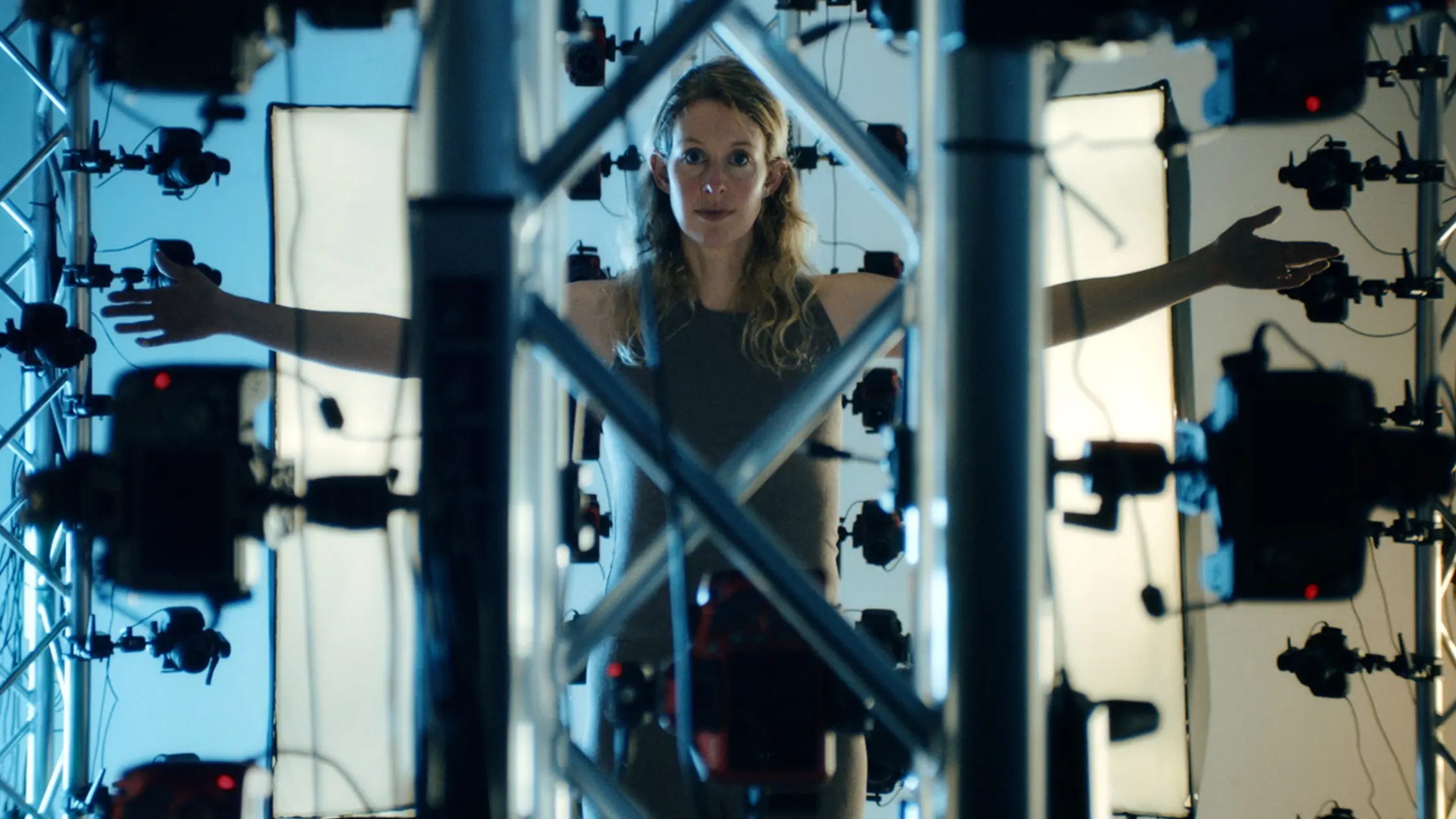
Years ago, I taught a university course titled “Gender, Psychoanalysis and Film” where students were introduced to the concept of the male gaze. The term gained currency in the 1970s and 80s through British film theorist Laura Mulvey. In her widely cited essay, “Visual Pleasure and Narrative Cinema,” Mulvey enlisted psychoanalysis in deconstructing forms of spectatorship—ways of looking—through the conventions of Hollywood films. She showed how female figures typically appear as passive objects facilitating the journey of a male protagonist rather than as active subjects. The spectator (a term that brought the psychology of looking into discourse on audience responses) was assumed to be a masculine subject who identified with the filmmakers and the cinematic apparatus of production. While masculine pleasure produced through the male gaze is active and domineering, according to Mulvey, female pleasure is passive and narcissistic. Her identificatory pleasure with the female figure in film is in “being looked at.” Female figures are gauged by their “to-be-looked-at-ness.
Mulvey enlisted psychoanalysis in framing masculine “scopophilia”—the voyeuristic pleasure of looking--as organized around infantile anxiety. In the protective darkness of the theater and through the phallic power of cinema itself, Hollywood shored up masculine defenses that were periodically threatened by the real-world assertion of female agency. Second wave feminism of the 1970s—the mass mobilization of women--was one of those periods of crisis.
Exposing the infantile anxieties hidden behind phallocentric forms of culture emerged as a key project of feminism. Along with other black feminist film critics, bell hooks extended this project with her work on the oppositional gaze—how black audiences bring critical ways of looking and responding to the white gaze as well as to the male gaze of Hollywood films.
After teaching feminist film criticism, I was inspired to join what Mulvey called for in her feminist “counter-cinema” and guided by hooks’s work on her oppositional gaze. With smaller cameras and a feminist critical lens, we could create different forms of narrative pleasure. For me, the entrée was through documentary filmmaking. I extended the participatory action methods of my field research studies into this medium.
Part of what is captivating about You can See Everything is its double-use of the gaze. His gaze meets hers in a contest over their stare-downs, as well as their commanding influence on spectators. There is a film noir motif running through the first half of the film as well. Mulvey extended her concept of the male gaze to classic film noir, where a detective attempts to discover the truth behind a femme fatale, a powerful and alluring woman skilled in the use of various sexual allures to conceal her villainous motives. The denouement centers on the detective’s triumph over the femme fatale who is punished—by death, banishment or prison-- for her cold ambitions.
Unlike the classic narrative films where the female figure has no agency—where her place in the drama is as object of a controlling male gaze—Elizabeth Holmes does bring active agency to this documentary in performing her redemption story. She captivates us because she is a woman who shoots for the moon and has been brought down low. We are implicitly asked as feminist spectators whether it is unjust to send such a pioneering woman and mother of infants to prison—a woman whose fault was perhaps only in the delusional belief in herself.
You Can See Everything brings into focus the era of Silicon Valley culture that produced commanding female figures--“girl bosses”—in the mold of Elizabeth Holmes. But as important context, the delusions of Holmes felt sane to her investors. The product she marketed –her diagnostic Edison boxes that no one could really explain--conformed to their neoliberal logic that markets and entrepreneurs are better equipped than governments to deliver health care. Like many female corporate executives of her era, Holmes routinely exploited feminist campaigns to break the glass ceiling in STEM research fields. The story she told in TED Talks and on the fundraising circuit with Bill Clinton and others includes other touchstone feminine-inflected moments as well: her deep desire to prevent the loss of loved ones before their time; her passion for protecting people from the trauma of having blood drawn from a needle; her insistence that a 19-dyear-old Stanford dropout could invent a machine that would “revolutionize how we deliver health care.” Young women could do anything if they really believed in themselves. Her faux feminism was a house of mirrors, organized around the singularity of her vision.
Laura Mulvey’s film criticism pointed to how the female subject and spectator could be seduced by the narcissistic pleasure of “being looked at.” In seeing You Can See Everything, perhaps at the half-way house where she is expected to be placed in 2027, I imagine that she will like the film very much. With thousands of sold-out theatrical screenings and near unanimous rave reviews, she is probably the most looked at woman of the year.
🎞️ Watch Official Trailer

💬 Share Your Thoughts
What are the lessons for feminists in the rise and fall of Elizabeth Holmes? Is she symptomatic of a broader pathology in the economy? Why do you think You Can See Everything is such a big hit?
Let me preface my remarks first by saying that at its inception, I, a tech guy for the past 50 years, was a big Holmes/Theranos fan. We WILL all have a desktop or smaller machine in the future that could provide these blood labs/assays. She might have done it had she brought on-board industry pros — from Siemens for example, whose machines she used that are the industry gold standard for this tech. But no, pumping the fake-it-until-you-make it kool aid to an audience thirsty for the next Steve Jobs - and a woman no less! — the story that should be rigorously psychologically documented is how she was able to snow so many.
Did you not see that oily snake slithering thru the movie?
Non-scientist, non psychologist, un-rigorous, faux “documentarian” Fielder trying to humanize rehabilitate or at least understand Holmes psyche - ends up looking only like arty profiteering — with some heavy leverage from A24 and Seyfried — on our undying fascination with the Holmes Svengali mystique - this while Holmes & Billy play Fielder to help him tell a sympathetic story that might keep the blood & oxygen flowing on the Holmes project /vision/delusion/scam
Perhaps the movie would have been better named: “There will be (more) blood.”
Enter your piece. Another one - a psychologist no less! - mesmerized by the Holmes gaze. “All good” this faux documentary? Oh please. Where were you subject matter expert at the trial to defend her on-the-spectrum delusion that she did no wrong? Better, I bid you study how easily so many professional investors (trained to never invest a dime before doing due-diligence — beginning with Show Me! — were duped.
It’s Oppenheim, not Oppenheimer